
Complete catalog
Vegetables and Grains

Physalis sp
We were introduced to this tasty variety of groundcherry in the form of a delicious gelato at the Culinary Breeding Network’s January 2020 Variety Showcase in Portland, Oregon. Seed grower Nate Kleinman of the Experimental Farm Network brought this variety, along with other edible treasures, to be turned into culinary magic by chef Sandro Paolini of Pinolo Gelato.
Nate Kleinman received seed for this variety from fruits being sold at a roadside stand in Niagara-on-the-Lake, Ontario, from a woman named Mary who had been growing and saving her own seed of this delicious groundcherry for many years.
The small gold and orange fruits are refreshing, sweet, and tangy with notes of pineapple and vanilla and other pleasant flavors. They are sweetest when large and golden, but we also enjoy them when they are green and sour.
Groundcherries are rich in vitamin C, beta carotene, and dietary fiber, with some B vitamins and a small amount of fat from the seeds. The ripe fruits are a wonderful snack in the garden, make delicious pies, and are a good addition to a salad. When our plants produce more than we need, they also became snacks for our chickens.
We were looking for a variety of groundcherry to grow in Utah, and being very impressed with the flavor of this variety we gave it a try. These plants thrived in our hot and dry climate with moderate watering and grew to 3 feet tall with a 4 foot spread — apparently much taller than the ground-hugging form they take in the milder summers of Ontario. The plants could easily be pruned to fit any number of growing spaces and would make an excellent patio garden plant. They are productive throughout the season until the first frost.
The abundant marble-sized golden fruits are easy to pull from their husks when ripe and will fall to the ground beneath the plant in great numbers. This plant may be a good candidate for growing with some sort of groundcloth for easy and clean harvesting of these bountiful fruits.
Seeds germinate quickly on bottom heat like tomatoes, though they will start a bit slower without it.
Packet: 50 seeds

Fagopyrum esculentum
This fast growing cover crop is ideal for warm weather months. It quickly germinates and creates thick biomass that can out-compete summer weeds, and feed your soil. The cute flowers bring in lots of pollinators, and the large seeds are easy to save for future cover crops, or as an edible grain.
We harvested these seeds from our friends cover crop at Top Crops farm.
Packet: 125 Seeds

Allium cepa
This Italian heirloom forms large globe-shaped sweet red onions that store well over the winter months. It’s an intermediate-day variety that performs best between latitudes 32-42º. Skins are great for people new to natural dyeing. You can get lots of color variations by playing with mordant type and pH balance.
Start seeds indoors 10-12 weeks before your last frost, or direct sow outdoors 4-6 weeks before your last frost.
Packet: 100 seeds
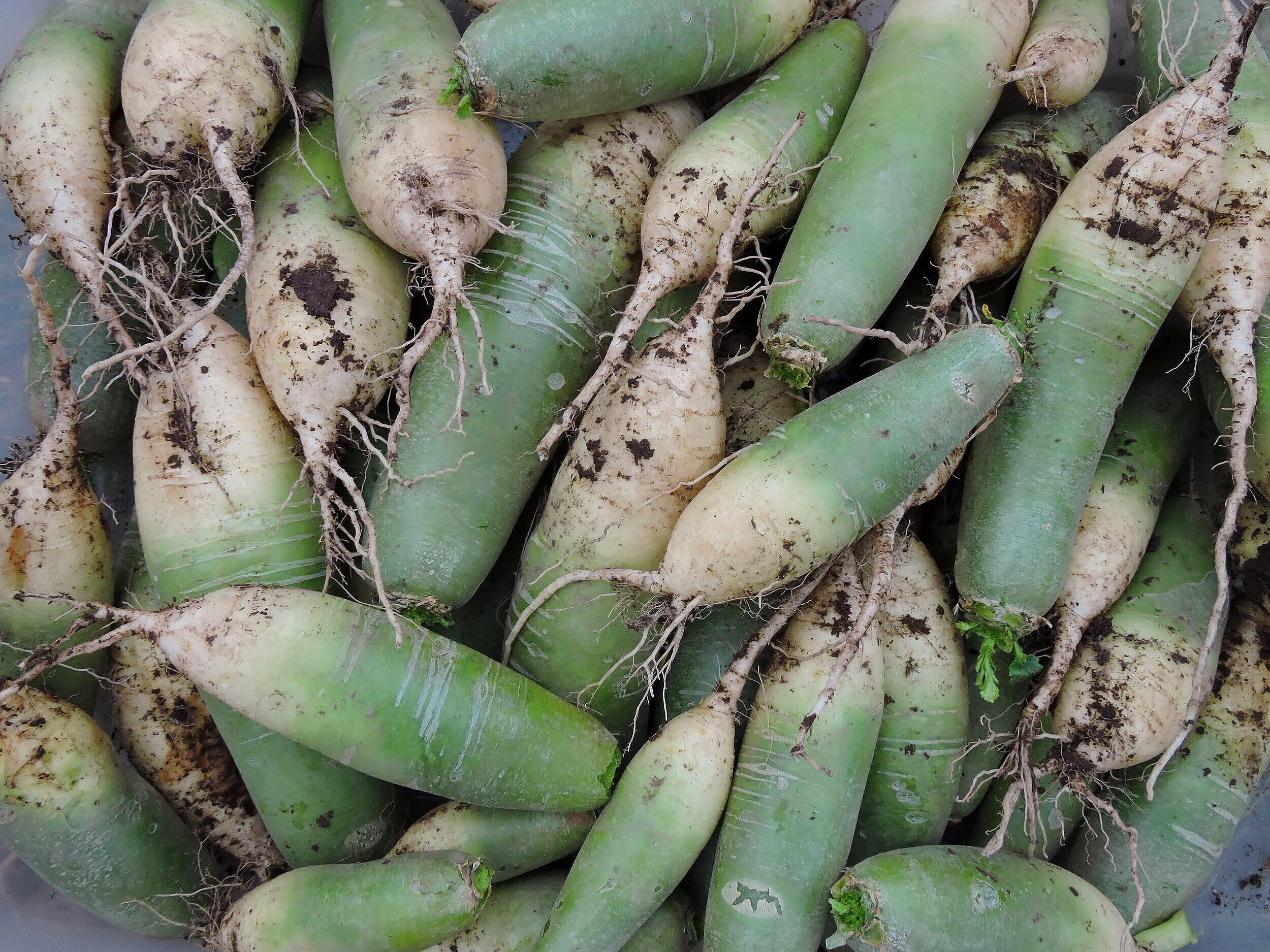
Raphanus sativus
This beautiful Chinese radish is a great spring or fall crop and stores well. They are fast growers that can get up to 12” long. We prefer to sow them in early August for an autumn harvest. If you let them go to bloom, the flowers and young seed pods are a delicious and beautiful garnish.
Direct sow seeds in early spring or late summer. Thin to 4” spacing, selecting for most vigorous seedlings.
Packet: 100 seeds

Raphanus sativus
These black-skinned radishes have a nice spice to them and get deliciously sweet after a few hard frosts (they retain some spiciness). We recommend sowing the seeds in August for autumn harvest, but you can sow them throughout the growing season.
We like these thinly sliced in salads, lacto-fermented into pickles, or baked with other root crops. We’ve also really enjoyed a traditional Russian recipe for coughs: Cut off the top of the radish and hollow out the center. Fill the cavity with honey, and let sit for 4-6 hours to allow the radish juices to be pulled into the honey. Stir the mixture, and take a tablespoon every few hours as needed. We thought the flavors wouldn’t be very complimentary, but found it to be very wholesome and earthy.
Packet: 100 Seeds
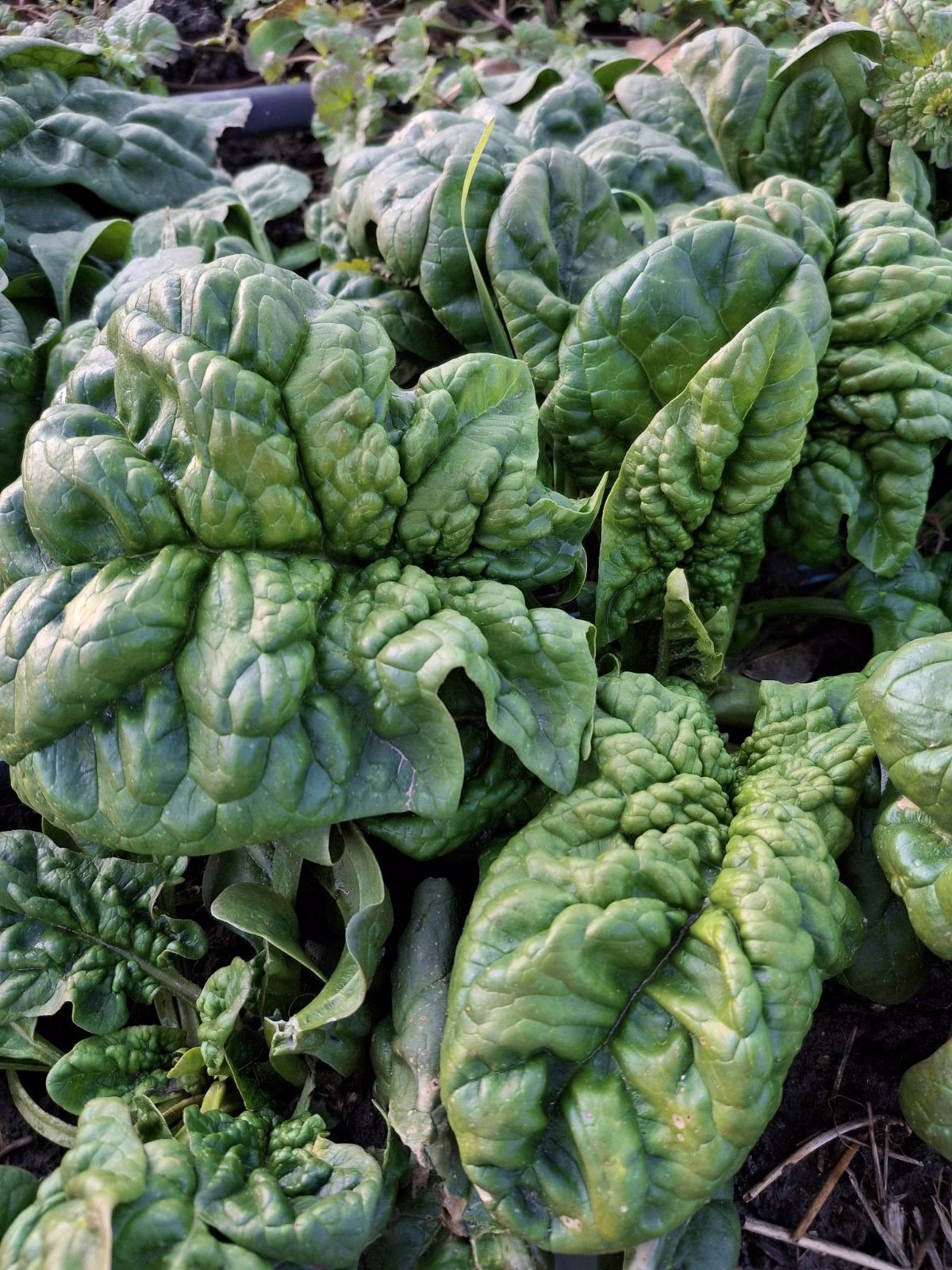
Spinacia oleracea
We’re thrilled to offer this exceptional spinach variety from our friends at Bug Farms in Salt Lake City, Utah. Known for its cold tolerance and robust flavor, Bloomsdale Long Standing Spinach is a favorite at Bug Farms. Here’s more about this beloved variety from Kristen at Bug:
Bloomsdale Long Standing Spinach has long been our go-to variety at Bug Farms for late fall, winter, and early spring harvests. We love it for its dark color and semi-savoyed leaves, and its buttery rich sweetness after it endures a couple of frosts. Being incredibly cold tolerant, we often plant it in September for winter and very early spring harvests. When given ample space, the plants and leaves become quite large and robust with sturdy stems that can be bunched. Sow seeds more tightly for a harvest of baby leaves. We love this variety so much we started growing our own seed to ensure we always have it in our repertoire!
Spinach seed prefers cool weather for germination, so avoid planting in warmer months. For baby spinach sow up to 5 seeds per inch, and for bunching spinach direct sow up to 10 seeds per foot.
Packet: 200 seeds
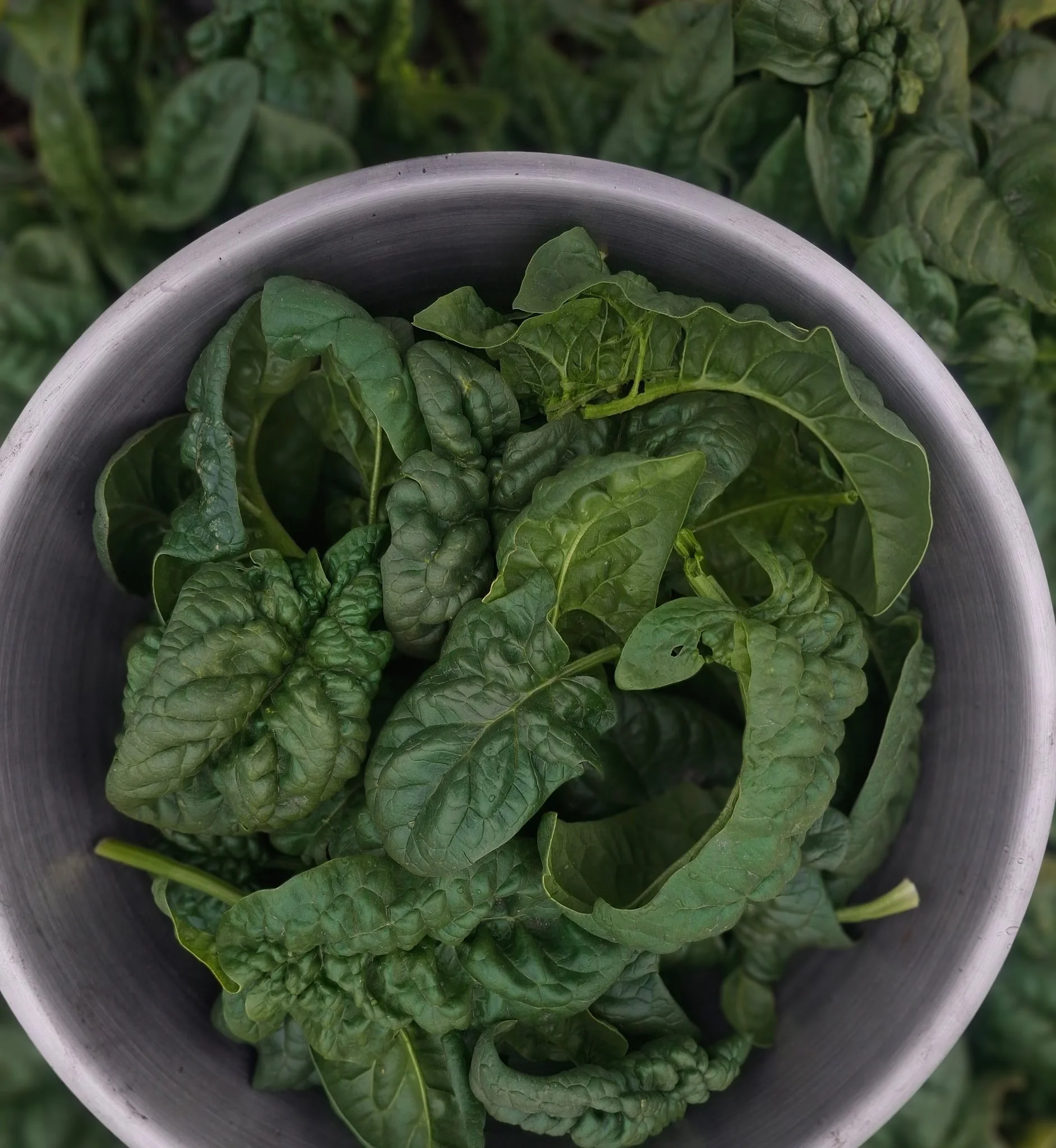
Spinacia oleracea
Another lovely spinach grown by BUG Farms. Here’s what they have to say about it:
This variety is known for being disease resistant. We love it for its large, savoyed and buttery dark green leaves, which only get sweeter after every frost. The stems are wildly tasty in the winter months.
Abundant Bloomsdale is a work-horse variety, especially in the shoulder seasons, as it is incredibly cold tolerant. Sow in the early fall for winter and spring munching.
Spinach seed prefers cool weather for germination, so avoid planting in warmer months. For baby spinach sow up to 5 seeds per inch, and for bunching spinach direct sow up to 10 seeds per foot.
Packet: 200 seeds

Eruca vesicaria sativa
Easy to grow and super delicious. We sourced our starter seed from Wild Garden Seed. The variety has a fair amount of variation, and our seed was collected from the 20% of plants that survived last winter without protection. We are hoping that the survivors are cold hardier, and not just lucky!
Seed from early spring through late summer. The flowers make a great edible garnish.
Packet: 200 seeds

Brassica napus
What do you get when you cross a genetically diverse kale mix (Wild Garden Kale Mix) to an extremely cold-hardy kale mix (Western Front Kale)? You get WILD WEST KALE! We actively rogued out under-performing plants and let our winter make the final selections. This mix has a variety of kale shapes, but the majority of them are in the Red Russian vein.
Kale tastes best after a few light frosts, so we like to direct seed ours at the end of July or early August and start harvesting in mid-October. If you are wanting baby kale for salads or micro-greens, you can sow throughout the season.
Packet: 250 Seeds
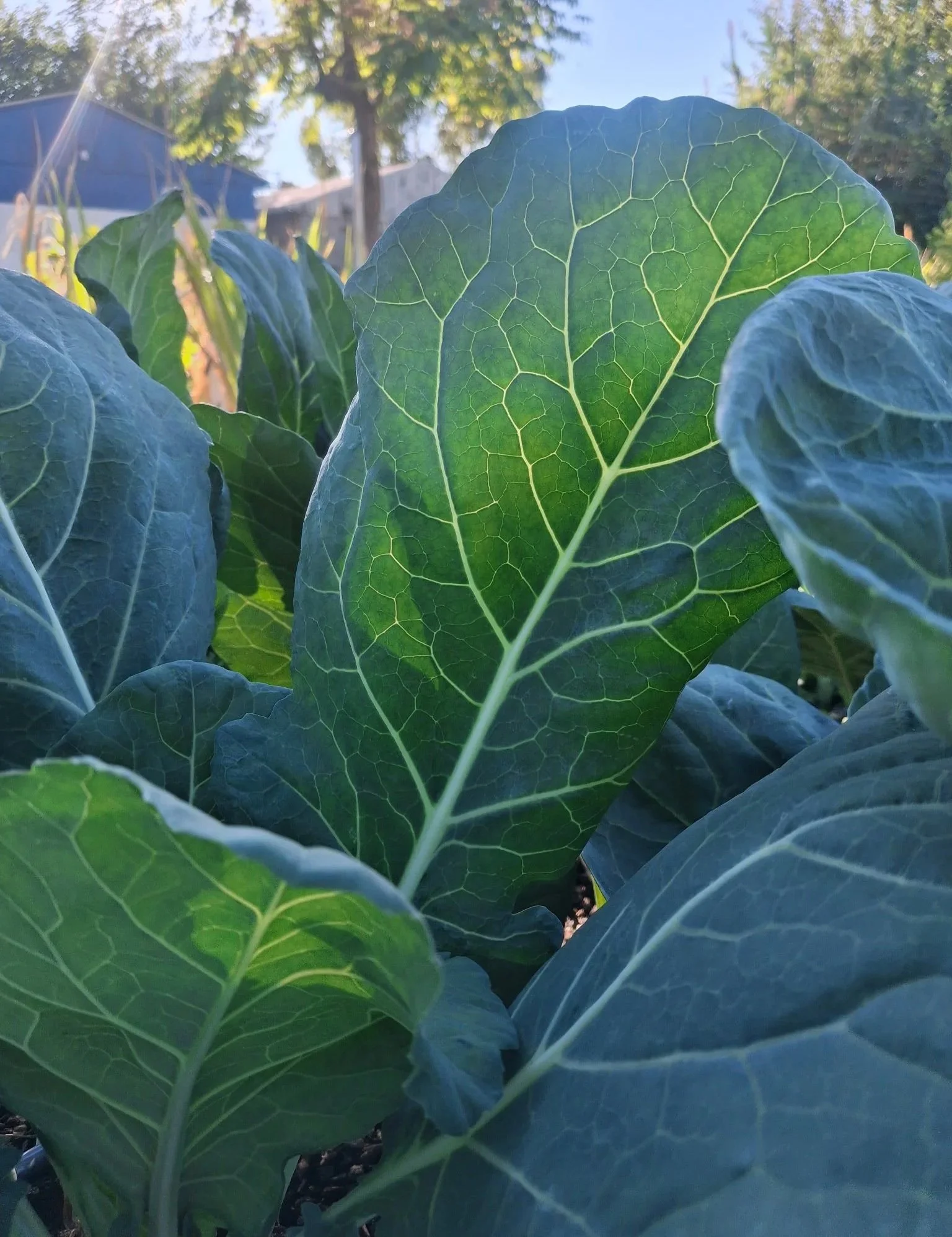
Brassica oleracea
This collard seed came to us from BUG farms here in Salt Lake City, Utah. Here’s what they have to say about the variety:
This diverse strain of collard greens were grown on our small farm in Salt Lake City, and they are the result of a natural crossing between 3 different collard varieties: Champion, Flash, and Vates. There were also some lacinato kale genetics in their heritage. While the leaves are rounded and large and distinctly collard-esque, you may be pleasantly surprised to see some unique shapes, textures and increased adaptability as a result of their genetic diversity.
These collards are both cold hardy and heat tolerant.
Direct seed or transplant in the spring for a summer harvest, or in the late summer for fall and winter harvests. The flavor and sweetness is enhanced after a frost.
Packet: 200 seeds
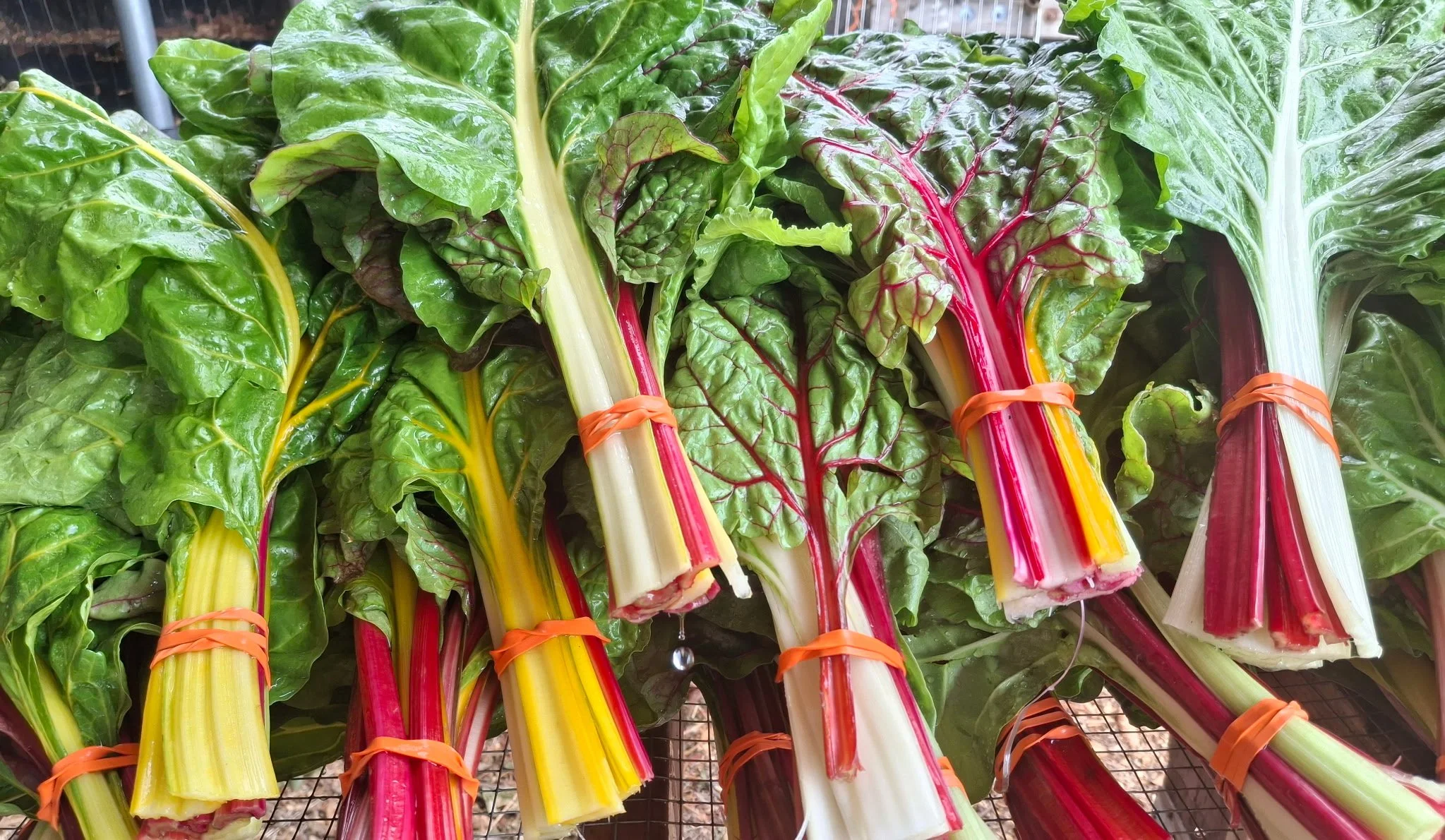
Beta vulgaris
A vibrant population of chard grown by our friends at BUG Farms in Salt Lake City, Utah. This selection shines with a beautiful mix of stem colors, dominated by classic reds and pinks. Direct sow from early spring through mid-summer, or transplant after your last frost date.
Packet: 100
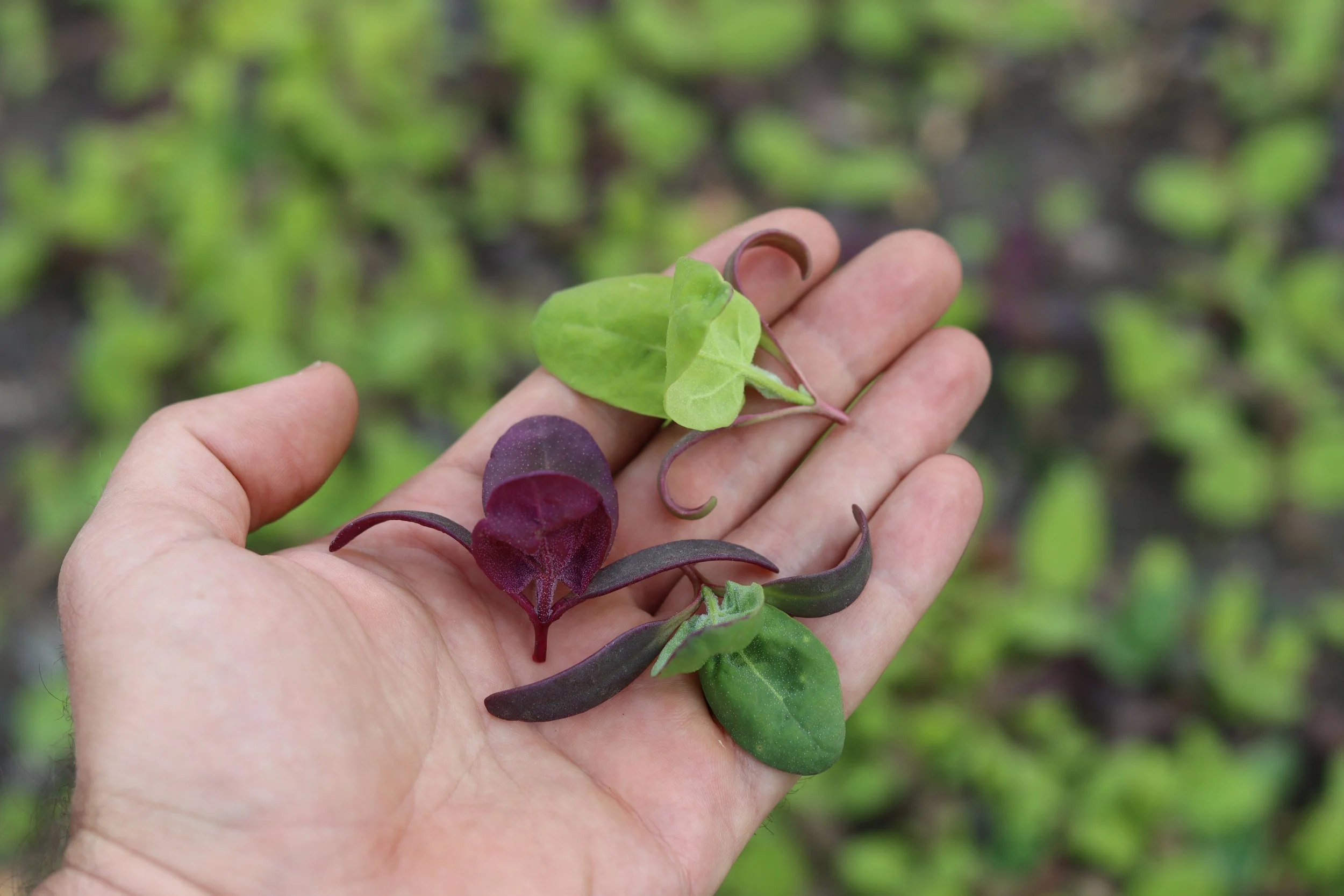
Atriplex hortensis
A striking blend of ruby gold, triple purple, and green orach. These varieties were grown together and allowed to cross-pollinate, so you may discover some interesting crosses as well!
Orach has a slight salty flavor which makes it a fun addition to a mixed green salad. After it has bolted, you can either save your seeds for replanting the following year, or cut the flower/seed heads to put in fresh flower arrangements.
Direct sow seeds in early spring.
Packet: 100 Seeds

Atriplex hortensis
So purple! If you like spinach but have a hard time growing it, you should give orach a try. This OSSI variety bred by Frank Morton of Wild Garden Seed is really beautiful, and does great in the heat when other greens are bolting. It has a slight salty flavor which makes it a fun addition to a mixed green salad. After it has bolted, you can either save your seeds for replanting the following year, or cut the flower/seed heads to put in fresh flower arrangements.
Packet: 100 Seeds
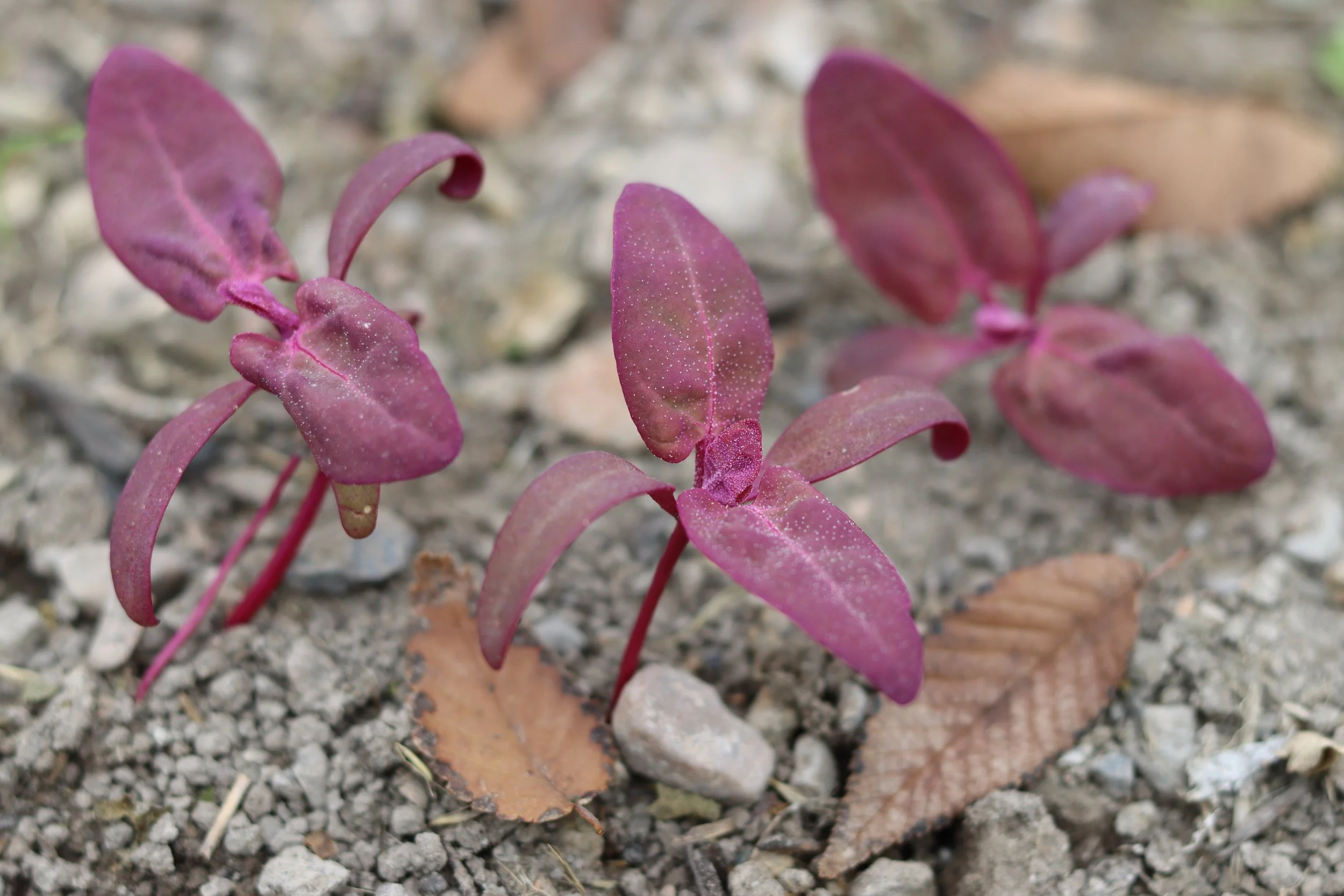
Atriplex hortensis
With its vivid, jewel-toned color, this orach is as at home in an ornamental garden as it is in a veggie patch.
Orach has a slight salty flavor which makes it a fun addition to a mixed green salad. After it has bolted, you can either save your seeds for replanting the following year, or cut the flower/seed heads to put in fresh flower arrangements.
Direct sow seeds in early spring.
Packet: 100 Seeds
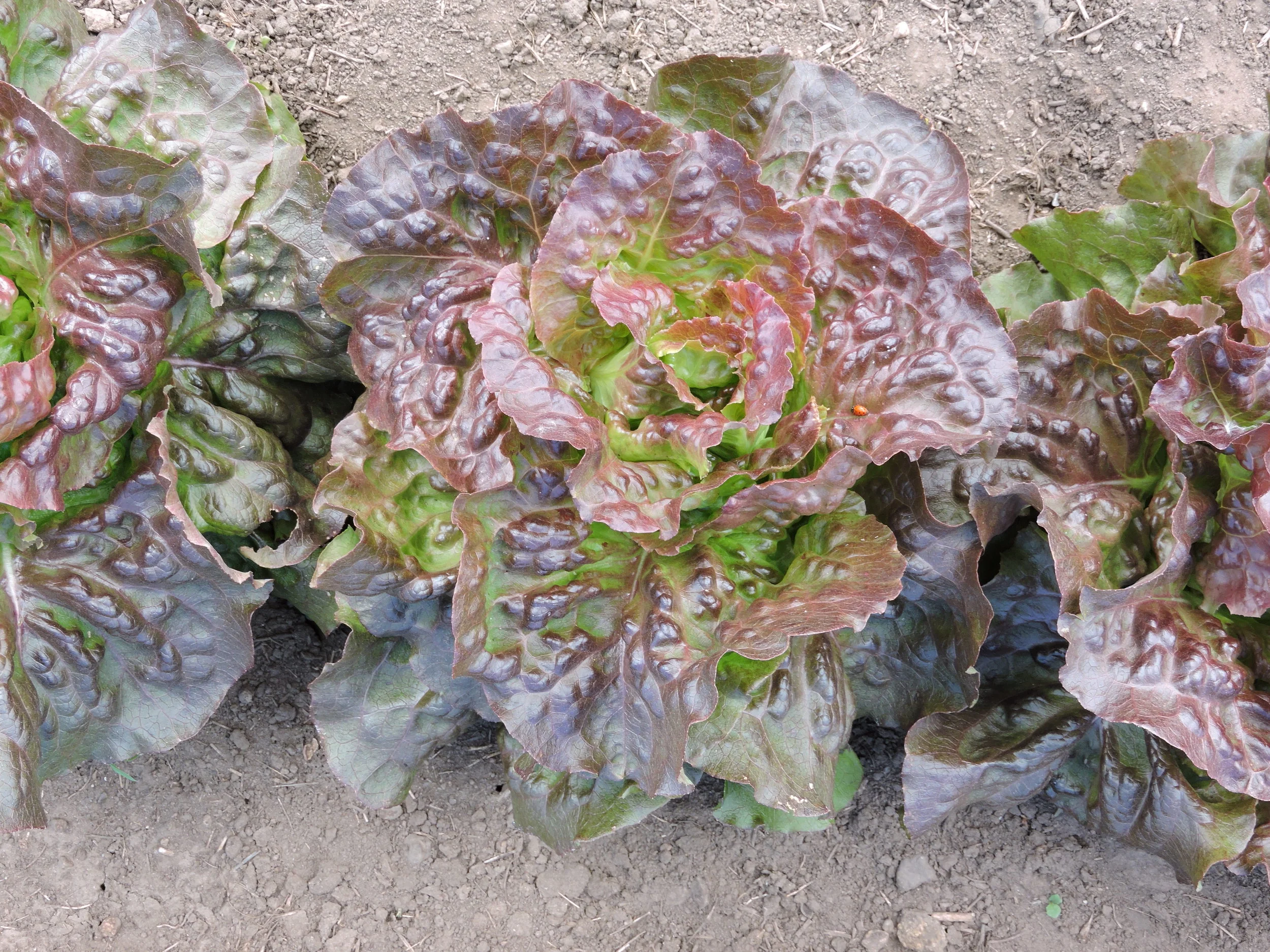
Lactuca sativa
Big beautiful butterhead. Excellent flavor and a dense heart. An old Canadian heirloom that Gathering Together Farm and Wild Garden Seed brought back from the dead. We love how massive these get before bolting.
Packet: 300 seeds

Lactuca sativa
Super dense butterhead lettuce. Resistant to tip burning and bottom rot. We don't have any great photos because the deer found this to be their favorite variety. Nice thick sweet juicy leaves.
Packet: 300 Seeds

(Lactuca sativa)
45-55 Days
Our favorite crisphead lettuce. Flavorful green leaves splashed with dark red specks. This is an all-season variety that does well in the summer heat and during the shoulder seasons. Makes for a stunning salad. This OSSI variety was bred by Frank Morton of Wild Garden Seed.
Packet: 300 Seeds
Celosia argentea
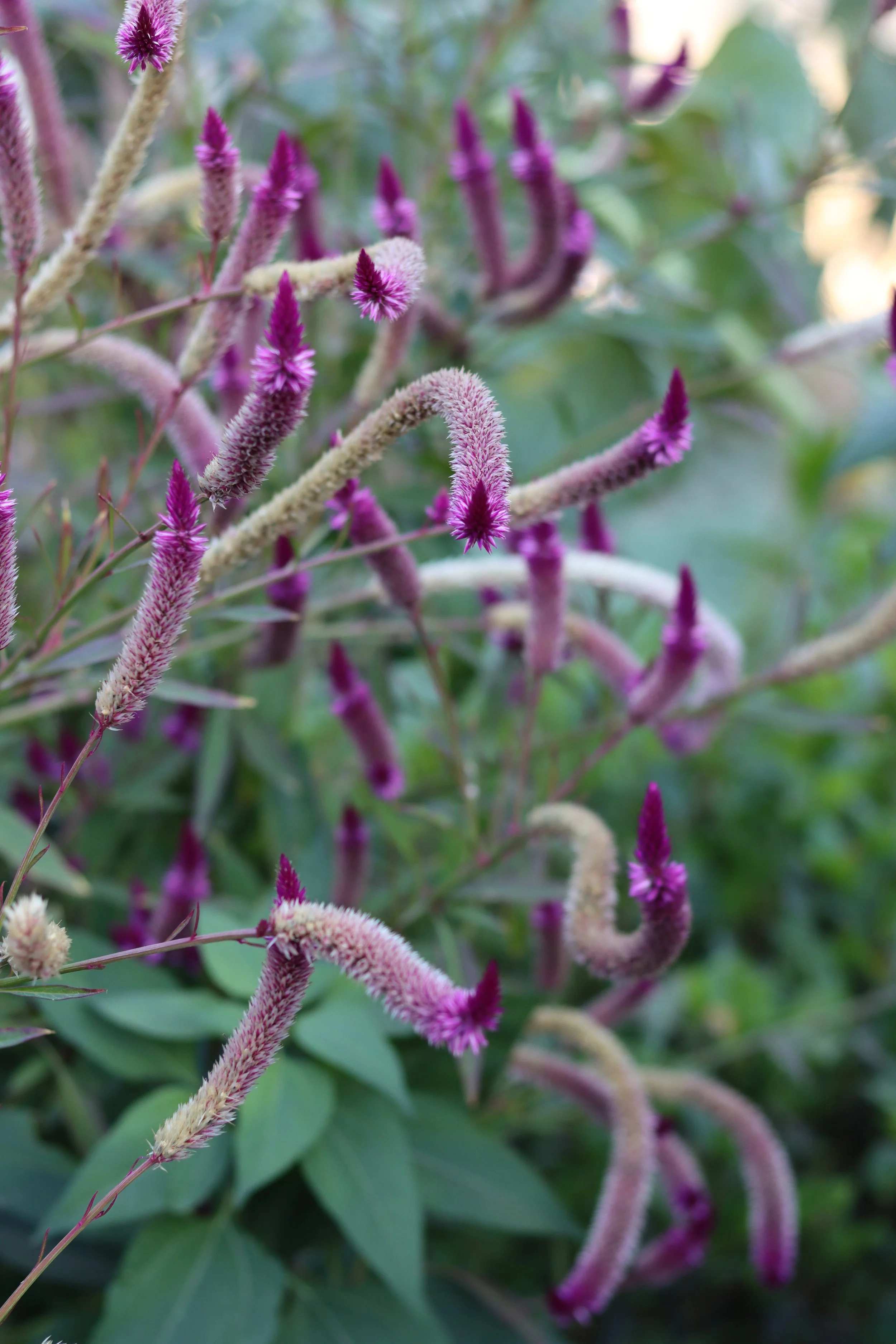
This cultivar of Lagos spinach produces tender, flavorful greens in the summer, complemented by striking pink and white flower spikes that add beauty to dried arrangements. In Nigeria, this plant is a beloved addition to soups and stews. To reduce oxalic acid, simply boil the leaves for a few minutes before adding them to your dish.
Start seeds once the soil has warmed up after your last frost date. We recommend surface sowing or lightly covering the seeds. Lagos spinach thrives whether transplanted or directly sown in the garden.
Packet: 200 Seeds

Eragrostis tef
If you have been intimidated by growing grains you should give teff a whirl! Teff is adapted to both water logged soil and drought conditions, and is virtually impossible to kill. Ours died back to the ground from a random hard frost in spring, and came back from the dead with a vengeance. After we harvested the first wave of grain, it decided to re-sprout from the ground and mature a second harvest in the same season!
Teff was domesticated in high altitude areas of Ethiopia and Eritrea by semi-nomadic populations who were able to replant large areas with just a small handful of grain. The seeds are protein and iron rich and used in the production of the sourdough bread injera. It makes a great addition to hot cereal.
We start ours indoors before the last frost, and transplant at 1' spacing.
Packet: 500 seeds

Chenopodium quinoa
Diverse white-seeded quinoa population bred by Frank Morton of Wild Garden Seed and listed as an OSSI variety. Beautiful color variation within the seed heads. Direct sown plants can get 7’ tall, our transplanted crop reached 3.5’.
Packet: 150 Seeds

Chenopodium nuttalliae
Excellent multi-purpose hot weather green! This Mexican plant thrives during the heat of summer. The young leaves are really lovely fresh in a mixed salad or sauteed with some garlic and olive oil. The best part of this veggie is the flower buds. They are so fresh and nutty! You can simply cook them up with some salt and butter, or you can do the extravagant Oaxacan recipe of huauzontles rellenos de queso. This recipe is to die for. Boil the buds, then form a ball of the cooked material around Oaxacan cheese. Batter the ball like you would a chile relleno, then deep fry. Serve smothered in mole or enchilada sauce. *DROOLING*
Packet: 500 seeds

Solanum melongena
Our favorite eggplant for stir fries and hot pots. No need to peel this thin-skinned variety. Start indoors on a heated tray, and transplant after danger of frost. Harvest often to promote more fruit growth.
Packet: 30 seeds

Physalis ixocarpa
Large fruited tomatillo variety with lovely green skin. Great for making salsa verde! Make sure you grow more than one plant, as they are obligate outcrossers and will not be able to pollinate themselves.
Start seeds on heated mats and transplant outdoors after danger of frost, or direct sow outside after danger of frost has passed. We give our plants at least 2’ spacing as they tend to sprawl. Full sun, and adequate nutrition will make them very productive!
Packet: 50 seeds

Capsicum annuum
This is our favorite pepper for making fermented hot sauces and sriracha. The spicy fruit is slightly smaller and milder than a typical jalapeño pepper. Beautiful purple flowers transform into equally beautiful peppers. We enjoyed the pop of purple in fresh salsas throughout the summer. The peppers mature from purple to red. The color of products made from the mature fruit is an incredibly bold fire engine red.
Packet: 30 Seeds

Capsicum annuum
Our favorite golden bell. We've been growing this for a few years now, and have found it to be widely adapted. The walls are thick and flavorful, the plants get loaded with fruit, and the peppers seem to mature quicker than other yellow or red bells. They are sweet and delicious raw, and make a great stuffed pepper or roasted pepper puree. This is an 1800s heirloom from Doe Hill area in Virginia.
Packet: 30 seeds

Allium fistulosum
A perennial bunching onion originally from China and Siberia and likely misnamed when introduced to Europe. Possibly descended from the Altai Onion (Allium altaicum) of China, Siberia and Central Asia.
This variety of bunching onions has hollow grey-blue to green leaves that grow up to around 2 feet tall with up to a 1” diameter and a red-skinned and white centered base. They form clumps of stems up to a foot across in a growing season with enough moisture and nutrition. These plants will typically bloom in their second season sending up blooming stems that have attractive off-white spheres of flowers that bring in lots of honeybees and other pollinators. The plants continue to produce ‘offsets’ or additional bulbs as existing parts of the clump bloom and set seed in their second year.
Can be propagated by bulbs, divisions, and seeds, giving it a wonderful ability to perennialize and be harvested on an ongoing basis.
The younger bulbs/stems are used much like scallions, and older offsets can be used like leeks. In the right growing conditions you can harvest from these onions in all four seasons.
Grow in full sun to part shade. They are tolerant of a wide range of garden soils. Avoid excess moisture.
Start seeds in late winter/early spring as they like cooler weather for germination.
USDA hardiness zones: 5-9
Packet: 150 seeds

AKA Black Salsify, Black Oyster Plant, Black Scorzonera
Scorzonera hispanica
This perennial vegetable is in the sunflower family and originates from the Near East and southern Europe. It forms tapering taproots (up to 3 feet long and 1 inch thick) and large wide leaves, both parts are tasty and nutritious. The roots and leaves are nutty and mild flavored. Harvest in the fall through winter or the second year for larger size. The roasted root is a coffee substitute like chicory root. Roots contain sticky latex and are cooked before eating and often peeled. They can be boiled then peeled if desired. If peeled before cooking, rinse with a vinegar or acidic juice (lemon) to prevent discoloration. The tender young leaves can be eaten raw, older leaves can be braised or lightly cooked, and the 2nd year yellow flowers are edible as well. The leaves persist into cold weather and can provide greens both late in the fall and early in the spring, at least at our USDA zone 6 field; warmer areas will have longer availability.
Black scorzonera flowers in the second year at about 3 feet tall in late spring to early summer. We think the 2 ½ to 3 inch diameter golden-yellow flowers smell like birthday cake!
Sow seeds directly in the spring at 10 to 12 inch spacing. They prefer full to part-sun and are tolerant of many soil textures and moderate pH. Produces best with average garden watering but can tolerate drier conditions. USDA cold hardiness zone 5
Packet: 50 seeds

Diplotaxis tenuifolia
This low-maintenance perennial green provides a spicy punch to salads, and it will readily self-seed in your garden. The flavor is similar to arugula, but slightly stronger. This is a great option for people who want lots of spicy greens, but don’t want to worry about successive sowings.
Wild arugula prefers to be direct seeded 4-6 weeks before your last frost date, when soil temperatures are still cool. In mild climates you can sow the seeds in late summer or autumn for harvest through winter.
Packet: 300 seeds

Setaria italica
Great multipurpose crop! Edible grain, great to grow as bird food (it was hard to keep song birds from eating our entire crop!), and beautiful in dried arrangements!
Start seeds indoors and transplant after frost, or direct sow late spring through early summer.
Packet: 200 seeds
Dye Plants

Persicaria tinctoria
We’re thrilled to offer three distinct and exceptional varieties of Japanese indigo this year, each with its own unique characteristics.
Growing and dyeing with your own indigo is an incredibly satisfying experience. There’s something so magical about watching your dye project transition from a murky yellowish-green to a brilliant blue as it oxidizes right before your eyes. Experiment with these three varieties to discover which works best for your climate and growing conditions.
Grand Prismatic Japanese Indigo: Our Japanese indigo is a diverse mixture of pink and white flowered genetics. The plants have intermediate-to-long leaves, and are very robust and bushy. We’ve been actively improving this mix for eight years, selecting for traits that are better adapted to our cool springs and hot, dry summers.
Chijimiba Japanese Indigo: This uniform variety is more upright than other indigo varieties, and has dark-green, waxy leaves with a cute crinkle to the leaf margin. We’ve heard it referred to as “ripple-leaf” and “crinkle-leaf” indigo. It also has lovely pink flowers. The waxy leaves appear to help the plant tolerate hot weather, but they also require a higher minimum temperature for fermentation extraction, as they resist fermentation longer than other varieties.. For fresh leaf dyeing with chijimiba, Liz Spencer of @thedogwooddyer recommends soaking the leaves in cool water for a few ours to overnight for better extraction. We’ve had success with fresh leaf without soaking, but noticed to took longer than with other varieties. Our original seed stock for this variety came from Britt Boles of @seaspellfiber, who is a fantastic resource for all things indigo!
Maruba Japanese Indigo: This round-leaf variety is particularly prized for making sukumo (dried indigo leaves that are then fermented). It has the most brilliant pink flowers of any indigo variety we’ve grown (the flowers pictured are from Maruba), and could easily pass as an ornamental in the garden. We noticed it was a little more sensitive to our cool springs and hot summers than our GPS variety and chijimiba, but it still produced a beautiful crop in our area. Maruba would likely thrive in more temperate regions. We received our original seed stock from Marion of @kokoroindigoculture, who is a dyer and artist in Basque Country, Northern Spain.
Growing Instructions
Start seeds indoors by lightly covering them with soil, seeds buried too deep will not germinate. We recommend slightly over-seeding your flats, and then selecting for the most vigorous seedlings. Transplant your starts after danger of frost. We prefer 1’ spacing, but know many growers in more temperate areas that like to tighter spacing. After your plants become productive, you can cut and come again throughout the season!
The most common issues we see customers have with indigo are: planting seeds to deep, allowing flats to dry out during critical times, insufficient light for seedlings (which is the most common problem we see with any indoor grown seedling), and using heat mats which may put Japanese indigo seeds into a dormant state.
Resources for Dyeing
If you are new to dyeing with indigo, Fibershed has some incredible educational materials on their website, including this PDF: The Production of Indigo Dye from Plants (which is what we follow for aqueous pigment extraction).
If you want a quick and easy indigo project that doesn’t require any chemicals, fermenting, or reducing, fresh leaf indigo dyeing is a great gateway project, and Liz Spencer of The Dogwood Dyer has a great tutorial for this method found here.
We are also excited to be offering Inside Indigo from Julia Tabakhova of @naettla for anyone wanting a beautifully illustrated deep-dive into the science and magic of indigo.
Packet: 150 seeds
Rubia tinctorum
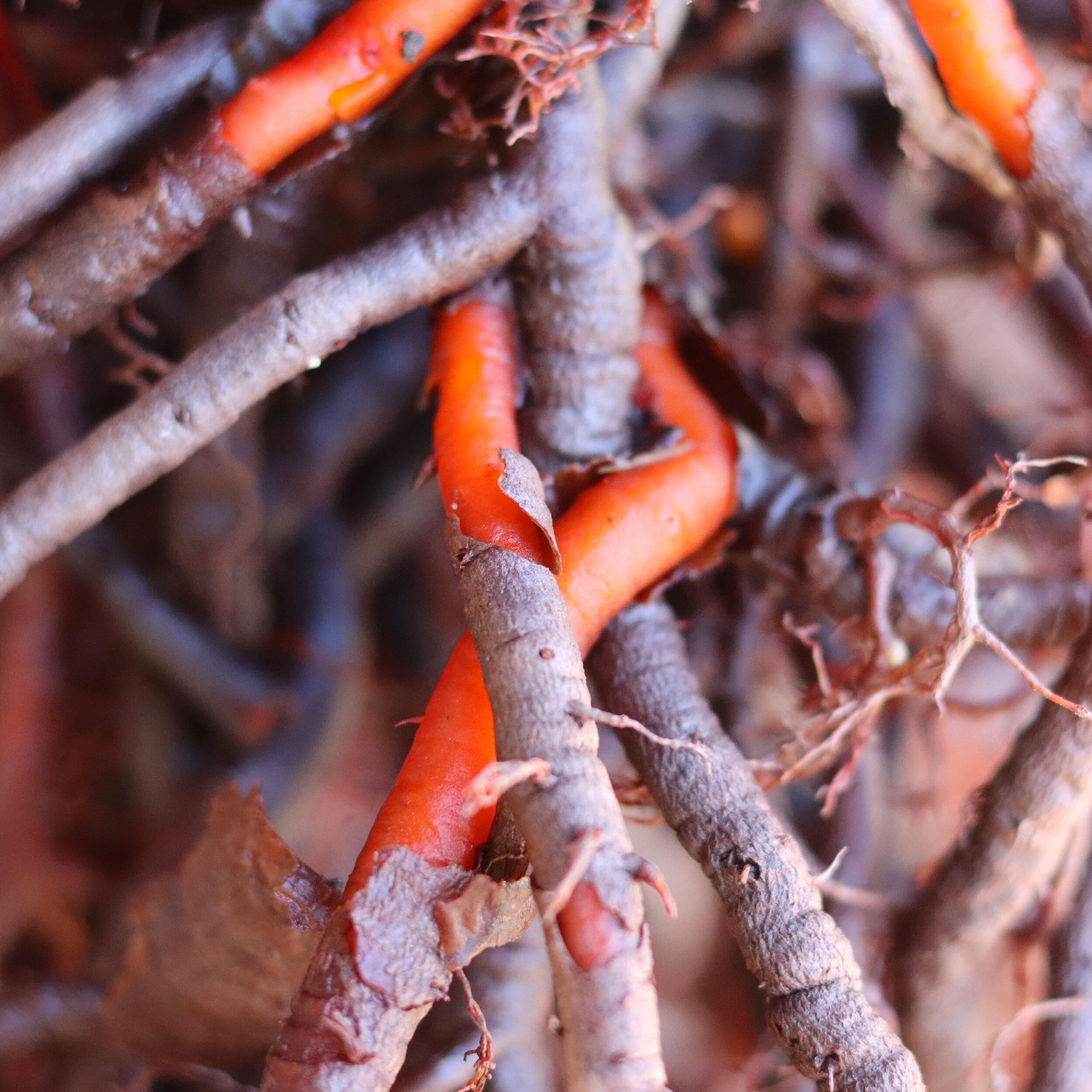
If there was one dye plant we would urge you to start this season, it would be madder. Not only does it represent a segment of the botanical dye rainbow that is difficult to acquire, but it also needs two years or more to reach maturity, which means procrastinating will keep pushing your harvest further and further into the future.
Madder was the primary source of red pigment throughout Eurasia before the Spanish colonized modern-day Mexico and began a violent campaign (both physical and cultural) to extract cochineal from native peoples. Some of the oldest pieces of red cloth found in archeological sites from India to northern Europe contain the pigment alizarin from madder. Its dye strength, paired with its light fastness has led to its longevity.
Start seeds when the soil is warm. We prefer to start them indoors on a heated tray, and transplant to 1’ spacing after danger of frost has passed. They take longer to germinate than many other dye plants, so be patient and make sure they don’t dry out while germinating. Trellis your plants to make weeding easier. Otherwise, the sticky/scratchy hairs on the plant cause a rash on your hands if you are trying to weed under their sprawling vines. Here in Utah, we put a few inches of mulch over our madder plants in late autumn to protect them from temperatures below -5º F. You can begin harvesting roots during the second autumn.
Packet: 50 seeds

Reseda luteola
Weld is arguably the strongest and most lightfast source for natural yellow dye. It is a biennial that will form a rosette in its first year, followed by blooms that reach 4-6’ in its second year. The flowers are beautifully fragrant, and are great to lure in pollinators. For dyeing, it’s best to wait until the second year and harvest the flowering stalks to use fresh or dried. You can also pick leaves from the rosette for dyeing during the plant’s first year.
Direct sow seeds in late summer for small overwintering rosettes or early spring for a more robust rosette that will bloom the following year. There always seems to be a few spring-seeded individuals that bloom the first year. You can also start seeds indoors in late winter and then transplant after your last frost. Its best to transplant them when they are still small so that their taproot doesn’t become stunted. Seeds can take up to a month to germinate. We always over-seed as many seeds have built in dormancy, and will come up sporadically. We gently sow seeds on the soil’s surface because they require sunlight for germination. Thin to 1.5-2’ to give room for large second year blooms.
If you don’t have a growing location with multi-year access to support biennials, Dyer’s Chamomile is a good alternative yellow dye in a single growing season. Dyer’s chamomile is also easier to start from seed.
Packet: 600 seeds

Double Flowered
Clitoria ternatea
This tropical leguminous vine from equatorial Southeast Asia produces the most beautiful sapphire blooms. Here in Utah it is grown as an annual, but in warmer climates it will perennialize. It is used throughout Southeast Asia to color foods, from sticky rice desserts to herbal teas. It is a great addition to cocktails that include a spritz of lime or lemon; the addition of acid will transform the beverage from a deep peacock blue to an electric purple.
Plants thrive in the heat, so make sure to plant your seeds when soils are very warm, or start indoors on a heated mat. It helps to scarify the seeds by nicking the seed coat with a razor blade, or rubbing lightly breaking the seed coat with some sand paper (our preferred method). We’ve had luck without scarifying, it just takes the seeds a little more time to imbibe, and you’ll have fewer seeds germinate.
It’s dry enough where we live to allow the flowers to dry on the vine, and collect them as they mature. In humid areas you may want to harvest fresh flowers and put them in a dehydrator on a low setting. Flowers can also be used fresh as an eye-popping edible garnish.
After having two subsequent crop failures for butterfly pea seeds (we had beautiful plants and flowers, but no seed set), we reached out to Laarni ofPetal Mettle Flower Farm on the north shore of O’ahu to help us produce seed for our catalog. We are so happy to host her beautiful seeds this season! Beyond growing beautiful flowers, Laarni also makes herbal products, like Butterfly Witch, which is a facial cleanser and toner that includes butterfly pea flowers 💙 🦋 💙.
Packet: 20 seeds

Scabiosa atropurpurea
This variety of pincushion flower has lovely dark blooms with contrasting lavender anthers. The long, straight stems lend to its popularity among florists. The flowers can be used fresh or dried for natural dyeing, producing blueish-green through purple and pink dyes depending on mordant choice and acidity of dye bath. It’s also great for bundle dyeing or hapazome!
Start indoors 4-6 weeks before your last frost date and then transplant to 1’ spacing. You can also direct sow after danger of frost has passed, making sure to keep soil moist during germination. Harvest heavily to encourage continuous blooms!
Packet: 60 seeds
Thelesperma burridgeanum (syn. Cosmidium burridgeanum)
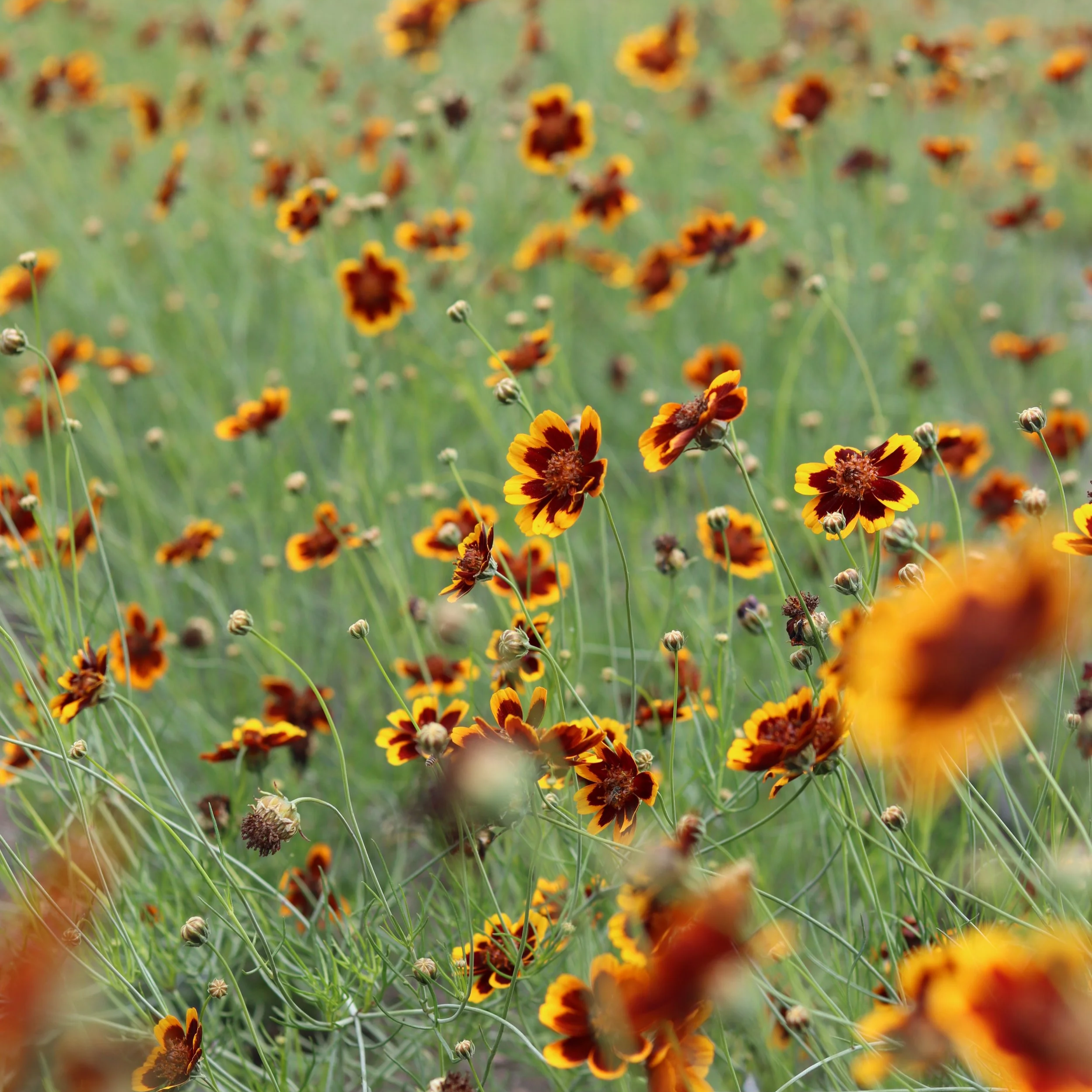
This stunning greenthread species (also known as Navajo tea) is native to Texas and northern Mexico and is remarkably adaptable. Given full sun, it thrives in a wide range of soil types. Plants bloom generously from summer until frost, offering a steady supply of nectar and pollen for native insects. In our own plantings, we witnessed cuckoo bees sleeping in the Cosmidium patch, gripping the stems with their jaws, an unexpected moment that we haven’t seen in our other crops.
Like its close botanical cousin Thelesperma filifolium, brunette cosmidium is a generous dye plant. The flowers yield rich oranges and rust tones on wool, while cotton takes on warm orange-browns, rusts, and deep chocolate hues. The stems and leaves also contain dye, and the plant’s two-toned blooms bring beautiful contrast and clarity to ecoprints.
Direct sow in late spring, or transplant after the last frost. Thin to 12" spacing. With average water, plants grow full and bushy. This plant is a wonderful addition to a pollinator or dye garden.
Packet: 100 seeds
Tagetes erecta
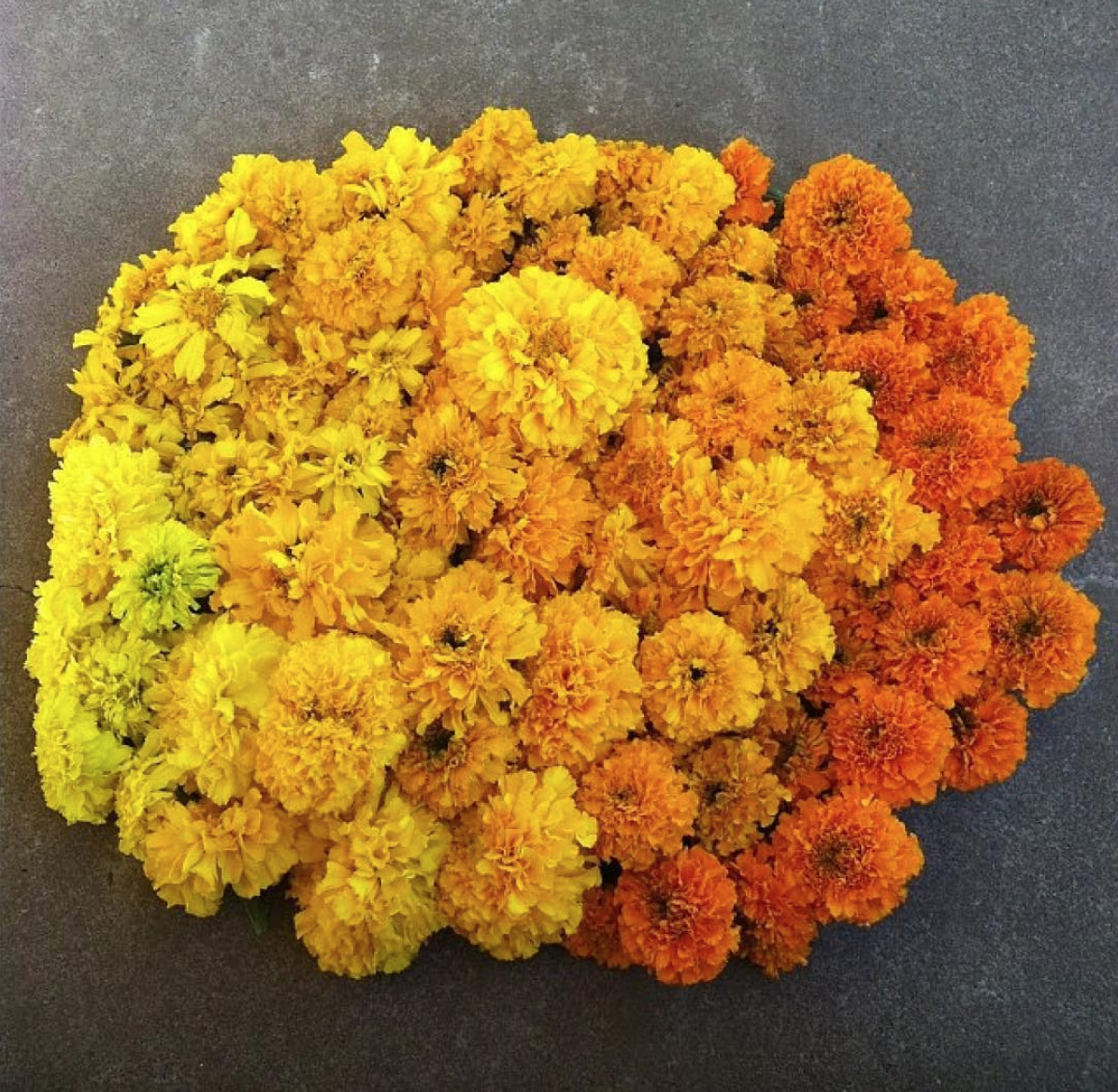
These 3'-5' tall monsters get loaded with stunning 2.5"-3" blooms from late summer through the first frost. POTENT dye. Why mess around with small French marigolds when you can get more dye for your pot with these bodacious flowers? Start seeds indoors and transplant to 1' spacing after danger of frost has passed.
Packet: 50 seeds

Tagetes erecta
Big. Thick. Juicy.
We're thrilled to offer these marigold seeds once again, thanks to Cody Egan of Driftless Seed Supply! Cody grew them out for us this year since we didn't have an isolation location for another marigold variety. We can't wait for you to enjoy them!
Packet: 50 seeds

Tagetes patula
This diverse French marigold mix contains single and double flowered plants, and a big range of fiery colors. French marigolds are perfect for pots or as a border plant in the garden. French Marigolds are prolific bloomers and will continue blooming until the first frost.
We grow this variety primarily for its yellowish orange dye on wool and cute prints on cotton fabric, but it is also great in bouquets or as an edible garnish (just make sure to remove flowers from the bitter flower base).
Start seeds indoors and transplant after your last frost, or direct sow in late spring or early summer when the soil has warmed.
Packet: 50 seeds

Coreopsis lanceolata
Simple and captivating. These bright and cheerful flowers are hypnotic.
Lance-leafed coreopsis is an abundant bloomer, which makes it a perfect addition to a perennial pollinator garden or dye garden. Lance-leafed coreopsis isn’t very finicky when it comes to soil type, and performs well under many conditions. Harvest the flowers often to prolong blooming, and use the petals fresh or dried for yellow and orange dyes.
Direct sow seeds in autumn through early spring. They prefer cooler weather for germination. You can also start the seeds indoors and transplant them in early spring.
Packett: 100 Seeds

Coreopsis tinctoria
This is our favorite dyer’s Coreopsis variety for eco-printing. The bicolor print on fabric is so striking! You can also obtain dye from the leaves and stems.
Beyond its use as a dye plant, dyer’s Coreopsis makes a great filler in arrangements, and it’s very popular with small native bees.
We prefer to direct sow seeds in early spring, but you can also start them indoors and transplant after danger of frost. The roots can be a tad fragile, so take care when transplanting.
Packet: 200 seeds
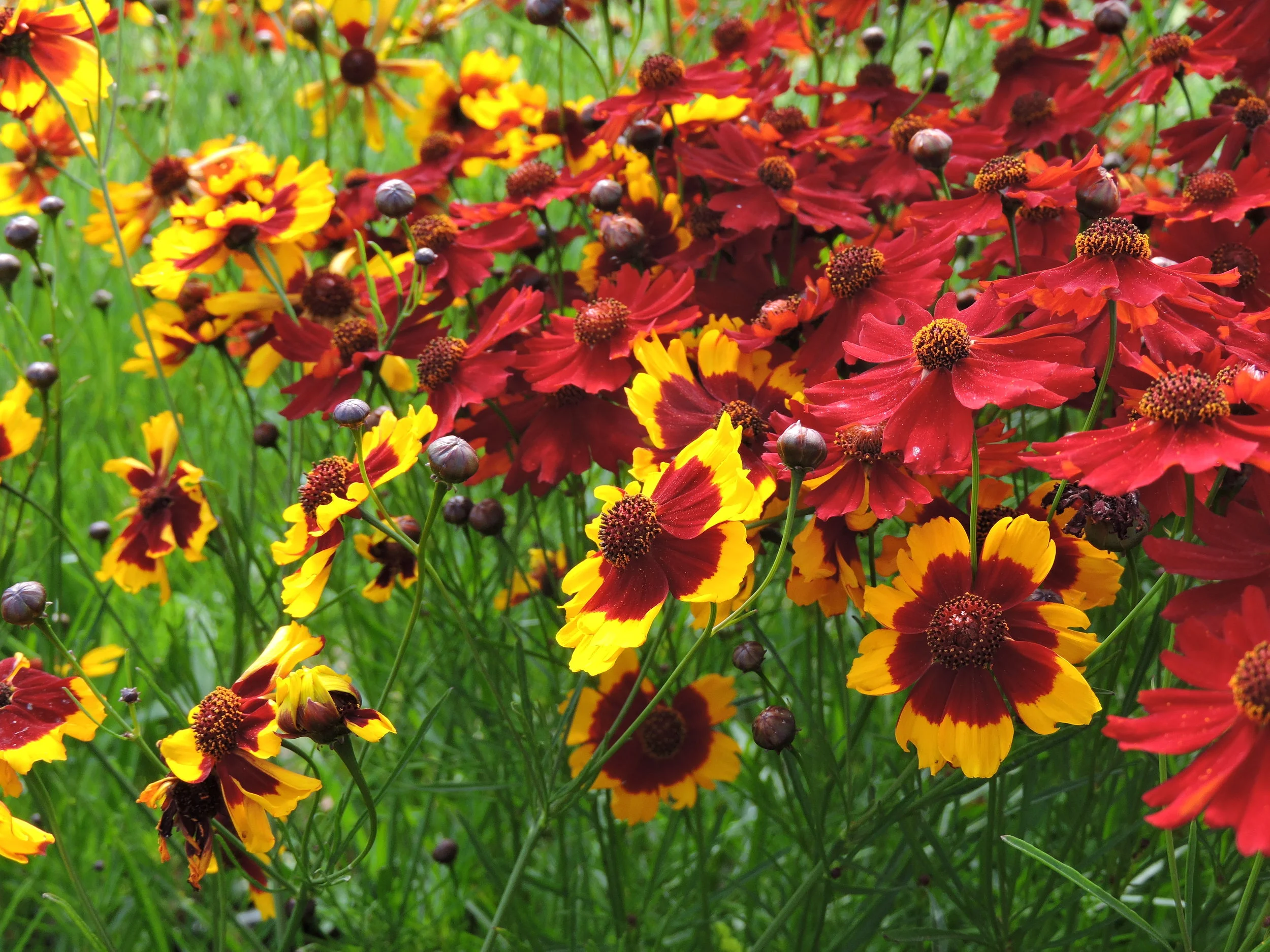
Coreopsis tinctoria
Also known as calliopsis, golden tickseed, or plains coreopsis, this wildflower is native to most of North America and Canada (with the exception, ironically, of Utah and Nevada).
Our population has a wide range of color combinations (all of which seem to make the native bees go wild!). It's always exciting to not know exactly what you are going to get until their adorable globe-shaped buds start to pop open! We've found that they do best when direct sown in early spring.
As for dyeing, oranges and browns are common colors from hot water baths. You can shift colors to a rusty red color with the use of a little soda ash. Best on wool or silk.
Packet: 200 seeds

Coreopsis tinctoria
We love this quirky dyer’s coreopsis cultivar! The skinny bicolored petals are excellent for bundle dyeing, and the whole plant can be utilized for dyeing natural fibers.
Like the dyer’s coreopsis mix we offer, this flower can be used to get beautiful oranges, browns, and rusty reds depending on mordants and modifiers. We direct sow in early spring as they don’t prefer to be transplanted.
Packet: 200 seeds

Coreopsis tinctoria
Beautiful wildflower and dye plant. This cultivar has deep red flowers that are PACKED with pigment for dyeing. Great for dark ecoprints, or immersion dyes. Prefers to be direct sown in spring and readily reseeds.
Packet: 200 seeds

This year, we experienced a crop failure with our hollyhock seeds, and new seed won’t be available until 2027. However, we DO currently have dried hollyhock petals available here!
Alcea rosea
These deeply pigmented bodacious double blooms are SO 👏 FREAKING 👏 BEAUTIFUL 👏! We are so excited to be adding this variety to our dye line-up this year! We also have petals for sale here if you want to try them out before committing to a biennial.
Depending on pH balance and mordant choice, you can get beautiful purples, blues, and teals with black hollyhock petals. Our climate is arid enough that we wait for petals to dry on the plant before removing them to store for dyeing. In a humid environment, you may want to harvest fresh flowers and dry them in a dehydrator to prevent mold from building up on the inside of the doubled petals.
Hollyhocks are short-lived perennials that are great at self-seeding. They can be a little temperamental to germinate, so we recommend over-sowing your seed and then thinning as needed. Direct sow in spring, about a week or so before your last frost date, or in late summer through early fall. Often times, hollyhocks will bloom their second year, so make sure to plan ahead! Sow groups of 3-5 seeds in 1/2” deep holes about two feet apart from one another. Thin each group leaving the strongest seedling behind. Make sure the soil doesn’t dry out while the plant is getting established. If you are seeding in late summer, you may want to lightly mulch the plant before winter to protect it in harsher climates.
Dead-heading your flowers paired with consistent watering will encourage blooming until your first frost. You can get an incredible amount of dye material from just a couple of plants over the course of the season.
Packet: 50 seeds

Cosmos sulphureus
We love how the fiery orange blooms of Tango Cosmos appear to be levitating when seen from a distance, especially when a slight breeze causes them to dance around on their barely visible slender stems. Up close you can see a beautiful orange and gold bi-color effect, something difficult for our camera to capture, making them even more precious.
There are so many reasons to grow this variety. The flowers are great for dyeing cotton or wool, the nectar feeds local bumblebees and hummingbirds, seeds feed the songbirds, and they provide the perfect vista to get lost in while day dreaming on a hot summer day.
Start indoors and transplant after your last frost, or direct sow after danger of frost has passed. Deadhead for an avalanche of flames that will go until your first frost.
The flowers produce a beautiful juicy orange dye. We love how vibrant it can be on wool.
Packet: 50 seeds
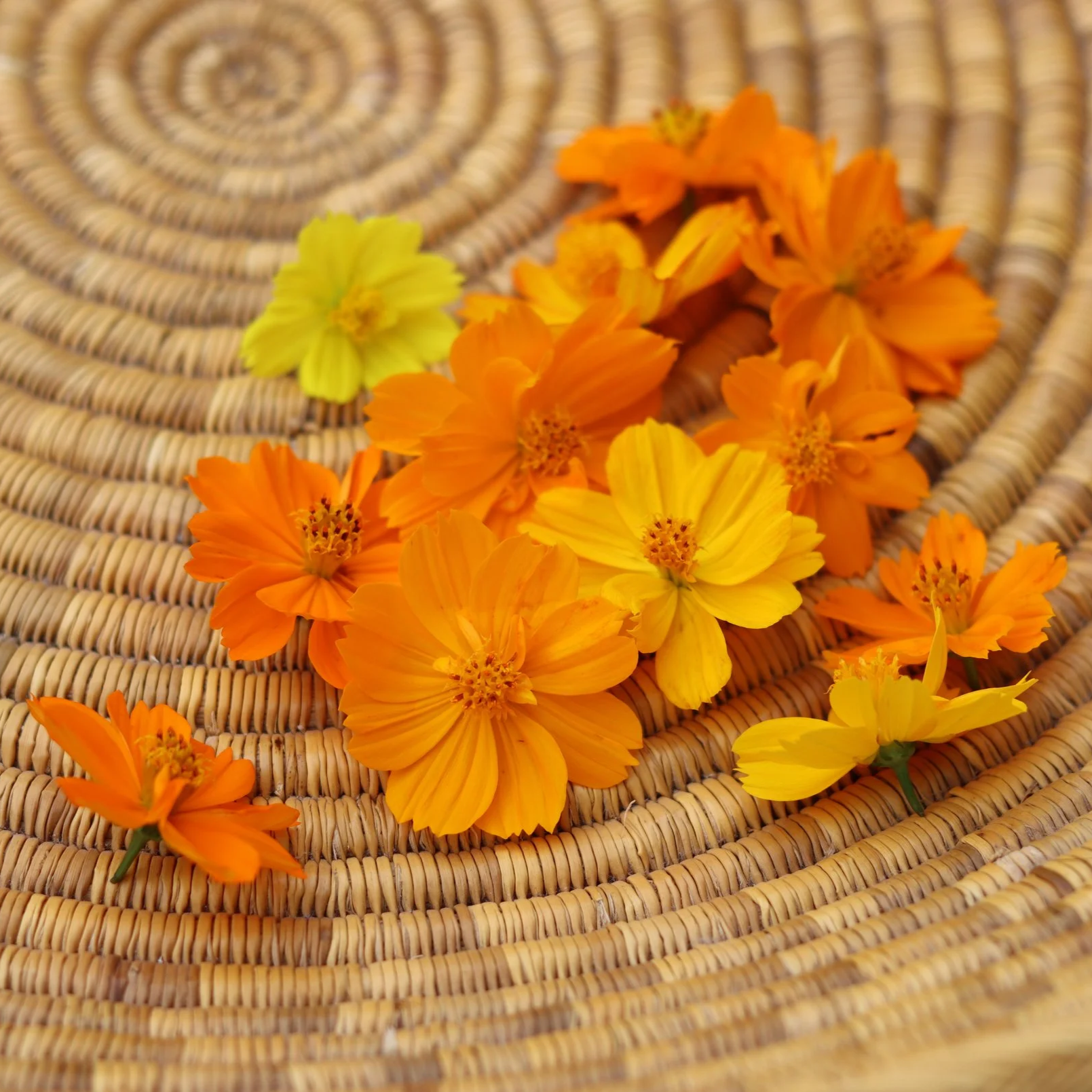
(Cosmos sulphureus)
This variety has similarities to Tango Cosmos, but is substantially more compact, and has a variety of colors from yellow to deep orange. You’ll also see an array of petal types from single petaled plants to semi-doubled. Ladybird Cosmos is great for patios and pots, and maxes out at 2-2.5’ instead of the 4’ that Tango Cosmos will reach.
Direct sow seeds when soils have warmed, or start indoors and transplant after danger of frost has passed. An excellent pollinator plant.
Excellent for bright orange dye!
Packet: 50 seeds
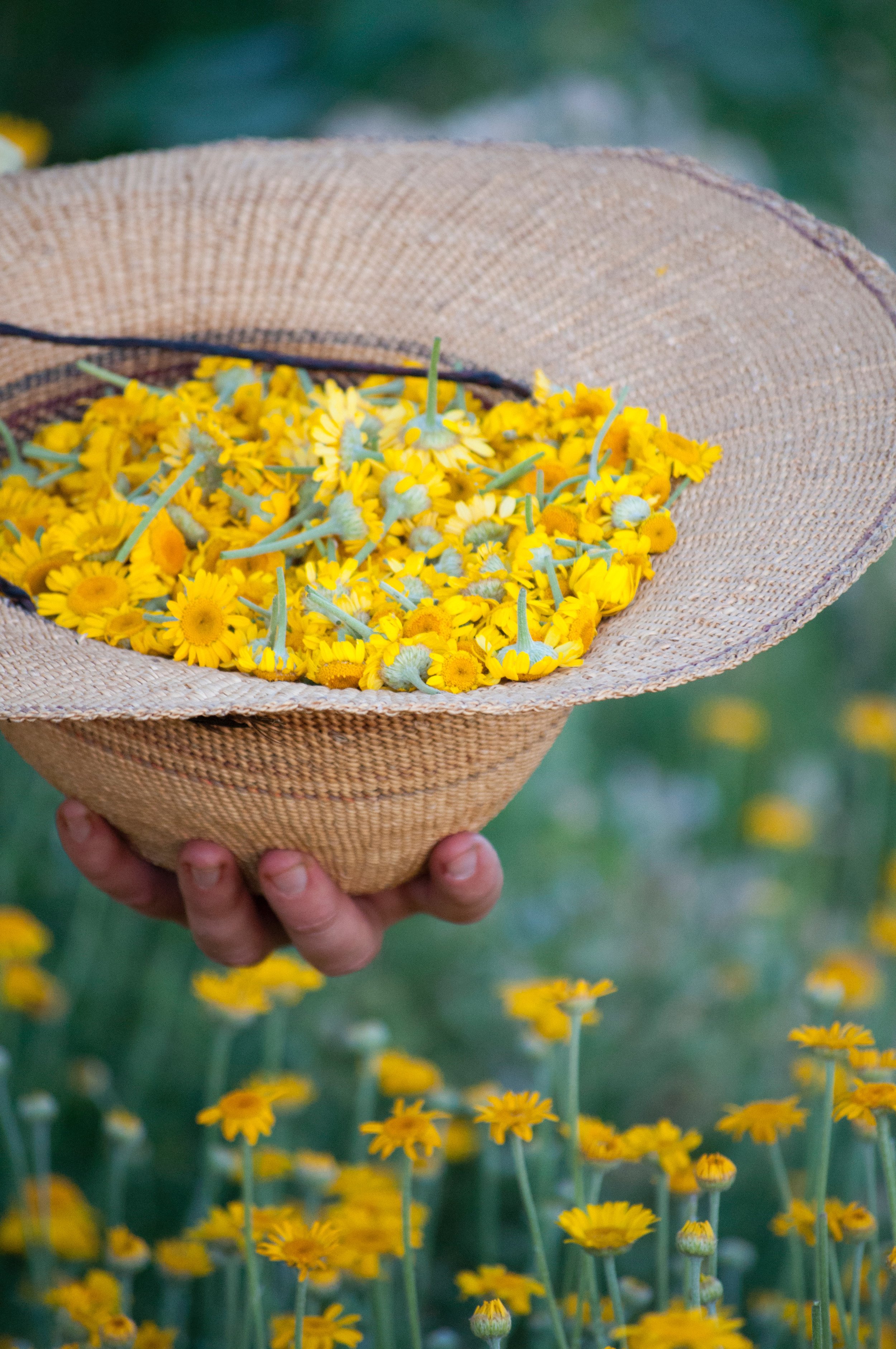
Cota tinctoria
Dyer's Chamomile is an extremely productive perennial dye plant. The yellows obtained from dry or fresh flowers are strong and crisp. EXCELLENT for over-dyeing with cochineal or indigo. It's also much more light fast than many yellow dyes. The plants themselves are beautiful and low maintenance. Little pops of sunshine with lovely greenish blue dissected leaves. Attracts beneficial insects like soldier beetles and syrphid flies.
Packet: 150 seeds
In 2026, 50% of online sales ($2.25 from every packet) for Hopi Red Dye Amaranth, Hopi Black Dye Sunflower, and Hopi Nicotiana will be donated to Hopi Tutskwa Permaculture. We are excited to support their work around food sovereignty through this indigenous seed benefit sharing partnership. Below is some information about their non-profit from their website. For additional information and ways to support their work, click here.
About Hopi Tutskwa Permaculture
Hopi Tutskwa Permaculture is a community Indigenous-led non-profit based in the village of Kykotsmovi, located in Northern Arizona on the Indigenous Hopi Reservation. Our mission is to create community-based solutions in order to pass knowledge to future generations and rebuild culturally sustainable and healthy communities. We initiate learning projects that engage, train, and inspire Hopi youth and community to revitalize Hopi culture, knowledge, and traditions. We support Hopi community members in developing leadership skills to strengthen local food systems and to implement sustainable ecological projects within the Hopi community. We aim to provide our community with the tools, training and practical experience needed to rebuild a vibrant community based on traditional Hopi values and worldview.
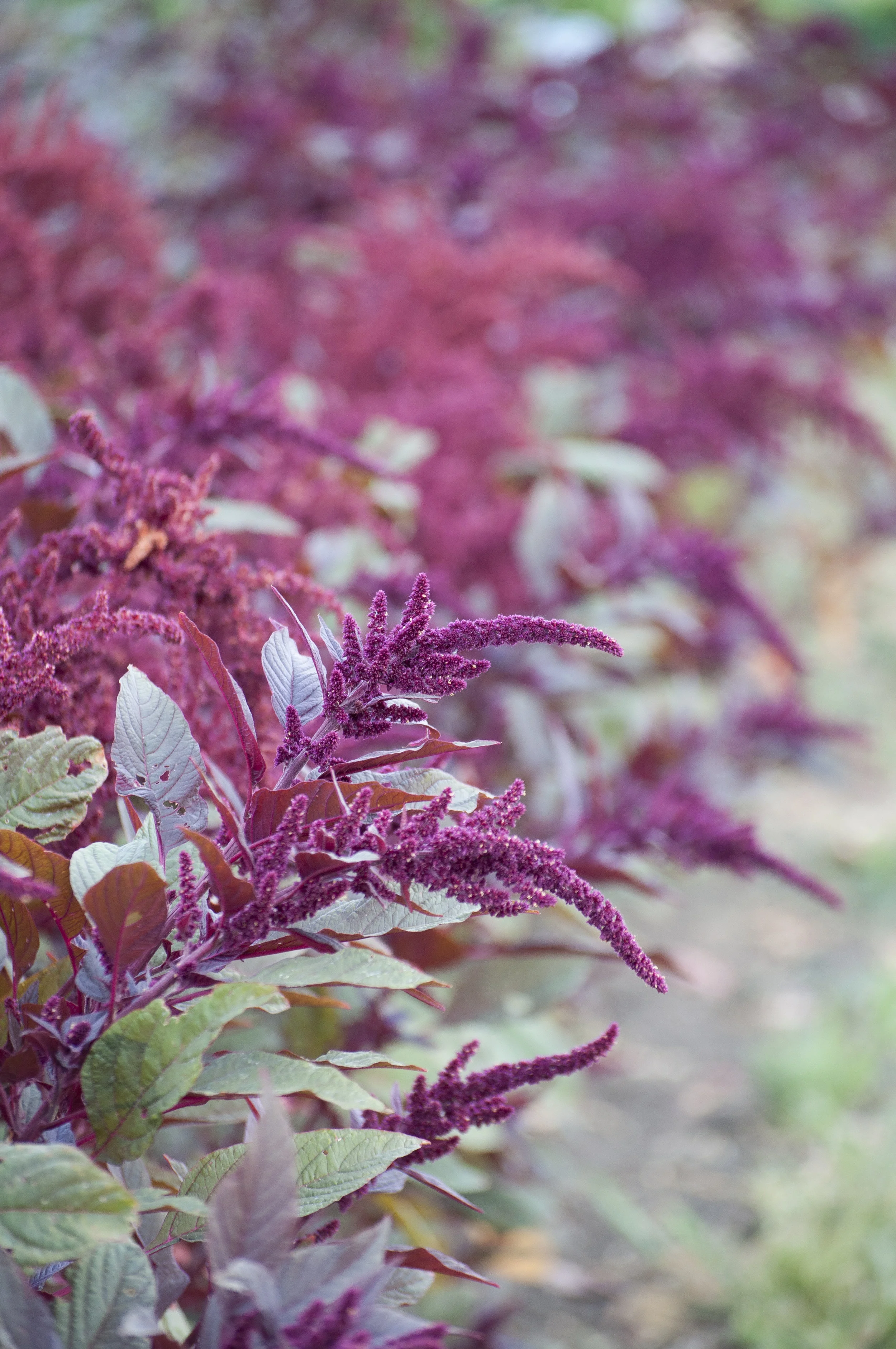
Hopi Red Dye Amaranth
Amaranthus cruentasx A. powelli
45 days leaf, 100 days grain
The flower bracts Hopi red dye amaranth (known as komo in Hopi), are used to color Hopi piki bread. Although it is best used as a food dye, you can use it to obtain yellows and oranges on wool with the use of mordants (it's about as light fast as turmeric or onion skins).
The leaves are best eaten when young and tender. The flowers are also STUNNING in arrangements (fresh or dried). We like dehydrate the flowers and then pulverize them to use as a food colorant.
Packet: 200 seeds
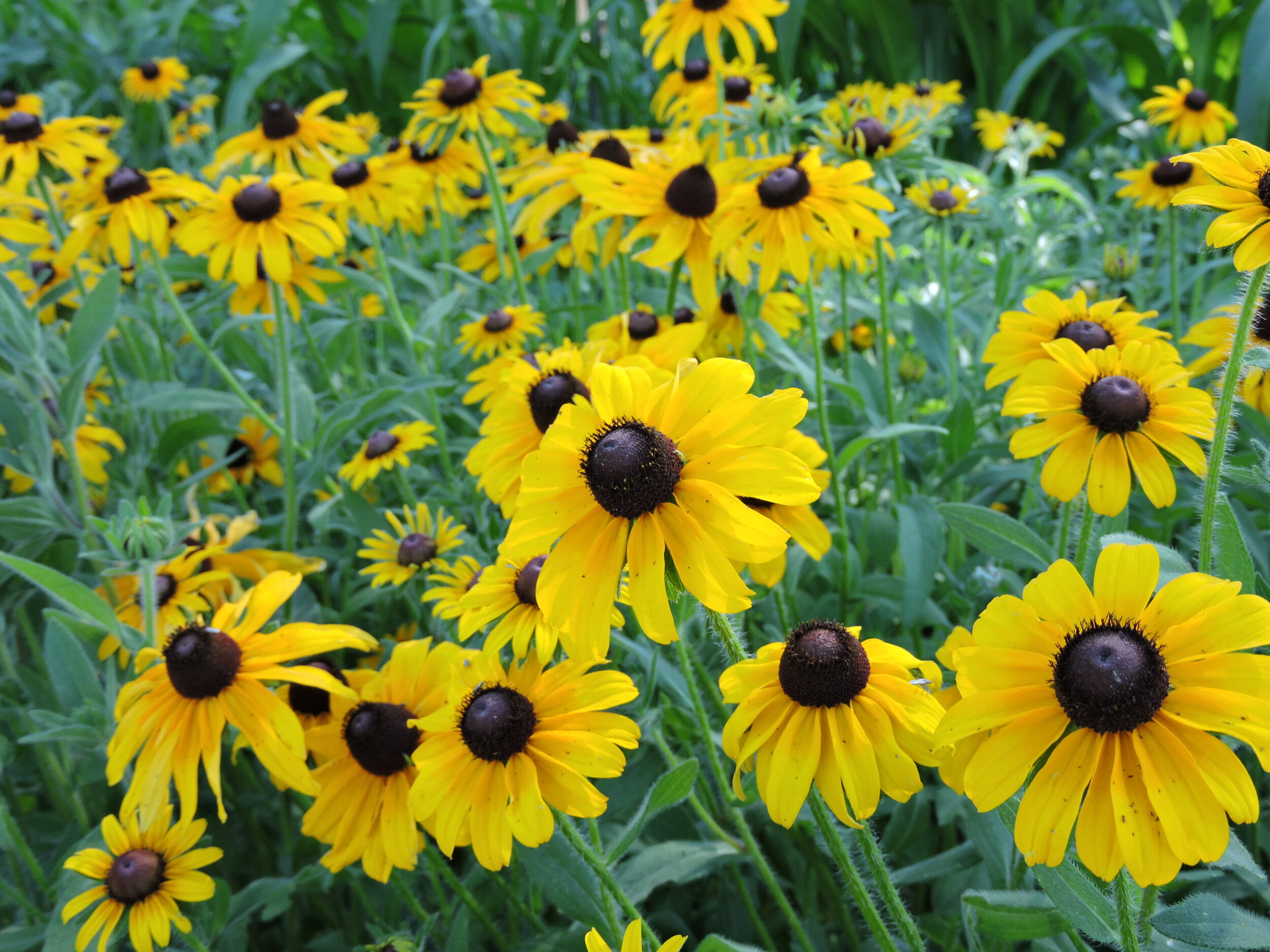
(Rudbeckia hirta)
This beautiful wildflower native to Central and Eastern North America is now naturalized throughout all contiguous US states and all Canadian provinces. The majority of our plants have solid yellow petals, with a few off-types being bi-colored yellow & red. It is a short-lived perennial in our region, and will act as an annual in very cold regions. Native pollinators love the exposed cone.
You can achieve beautiful sage greens on mordanted wool or cotton using either fresh or dried flowers. The body of the pictured sage green wool sock was dyed with black-eyed Susan; the toe with juniper mistletoe. The other sock was dyed with Hopi black dye sunflower seeds and black hollyhock flowers. The cotton bandanas pictured were dyed with black-eyed Susan.
Direct sow seeds anytime between your first frost and last frost. Seeds take about two weeks to germinate. You can also sow seeds indoors, and then transplant after danger of frost to 1’ spacing.
Packet: 200 seeds

Carthamus tinctorius
Stunning addition to any garden. The petals contain the pigment carthamin which was an historically important food and cloth dye until the development of synthetic aniline dyes. Egyptians were using it as a source of dye as early as 3500 B.C..
In addition to dyeing, you can also use Safflower as an aromatic spice or as an herbal tea. The seeds make a stable vegetable oil.
We have a comprehensive blog post all about Safflower (growing, seed saving, dyeing, etc) that you can find here: Safflower Soirée: A Guide to Growing, Dyeing, and Seed Saving
Packet: 50 Seeds

Rumex hymenosepalus
A Buckwheat family (Polygonaceae) perennial wildflower native to the arid Western United States and Northern Mexico with thick, waxy and wilt-resistant leaves. They are grey-green to bluish, often with wavy edges and they are ridged with a central channel to collect and send moisture down to its roots. Blooms grow 2 to 5 feet tall in late spring to early summer and reappear opportunistically later in the season.
Sand dock’s flowering stalk and seed heads can provide a beautiful display. The flower stems emerge ranging from yellow-green with yellow to pink buds to pink to rosy-rust flower heads and young winged fruits that darken to rusts and browns at maturity all while providing a strong visual contrast with the bold foliage. It can be surprising to come upon these plants with such striking wide leaves compared to the surrounding arid region vegetation with its small and often grey foliage. In dry summer conditions leaves will die to the ground after blooming and seed set given enough spring moisture. Sand dock can re-emerge and bloom again if it receives enough rain or irrigation water.
Sand dock is a tough, very drought-tolerant plant that is well adapted to infrequent or low moisture availability. This is largely due to its network of thick, tuberous roots that often grow deep in sandy or loose soils chasing after moisture and storing it in tissues for future use.
Sand dock is also called Tanner’s dock because of its high content of tannins useful in leather tanning as well as for natural dyeing processes. In dyeing, the roots can be used in the mordanting process of natural fibers, or as a substantive dye that yields tans, reddish brown, greens, and grays depending on modifiers.
Best grown in full sun to light shade.
Average to low water, possibly none after establishment.
Tolerates many soils including heavy clays, but prefers well-drained soils.
Direct sow seeds in early spring, or start indoors and transplant after danger of frost. Established plants can be divided in spring or fall.
USDA hardiness zones: 6 (at least)-10
Packet: 25 seeds

In 2026, 50% of online sales ($2.25 from every packet) for Hopi Black Dye Sunflower, Hopi Red Dye Amaranth, and Hopi Nicotianawill be donated to Hopi Tutskwa Permaculture. We are excited to support their work around food sovereignty through this indigenous seed benefit sharing partnership. Below is some information about their non-profit from their website. For additional information and ways to support their work, click here.
About Hopi Tutskwa Permaculture
Hopi Tutskwa Permaculture is a community Indigenous-led non-profit based in the village of Kykotsmovi, located in Northern Arizona on the Indigenous Hopi Reservation. Our mission is to create community-based solutions in order to pass knowledge to future generations and rebuild culturally sustainable and healthy communities. We initiate learning projects that engage, train, and inspire Hopi youth and community to revitalize Hopi culture, knowledge, and traditions. We support Hopi community members in developing leadership skills to strengthen local food systems and to implement sustainable ecological projects within the Hopi community. We aim to provide our community with the tools, training and practical experience needed to rebuild a vibrant community based on traditional Hopi values and worldview.
Hopi Black Dye Sunflower
Helianthus annuus
Sunflowers are one of the oldest domesticated crops from North America, and this variety was selected over many generations for its beautiful pigment and large edible seeds. Known as Tceqa' Qu' Si in Hopi, Hopi Black Dye Sunflower is a traditional dye used in Hopi basketry and wool works.
We’ve been growing this variety since 2013, and it has consistently been one of our favorite sunflowers. We like a sunflower that is tall (7-11 ft ✔️), has large delicious seeds (✔️), and is gorgeous in arrangements (✔️). In addition to these traits, this sunflower is an absolute joy to dye with. The dye pot smells like a sweet and earthy sun-drenched summer day, which is EXACTLY what we need from a dye pot during the last days of winter. The colors you can obtain from the seed hulls range from a gentle warm lavender to a cool black velvet. Beautiful on wool or cotton. We recommend snacking on the seeds through autumn and saving the hulls for winter dyeing.
We direct sow seeds around our last frost date. Avoid starting sunflowers indoors as they quickly become etiolated without full sun and are stunted when transplanted. As your seeds are emerging, thin the plants to 2’ spacing, selecting for dark pigmented cotyledons which correlates to seed hull color (note the darkly pigmented seedling in the bottom photo compared to the less pigmented individual that we would remove).
Packet: 25 Seeds

Centaurea cyanus
This strikingly beautiful corn flower is great for cut arrangements or used as an edible garnish on summer cocktails. Bachelor's Buttons are almost effortless to grow. Direct sow a couple weeks before the last frost or in early autumn for earlier blooms. If you harvest heavily they will continue blooming from early spring until the first hard frost.
Dried flowers can be made into watercolors or food dye!
Packet: 75 Seeds
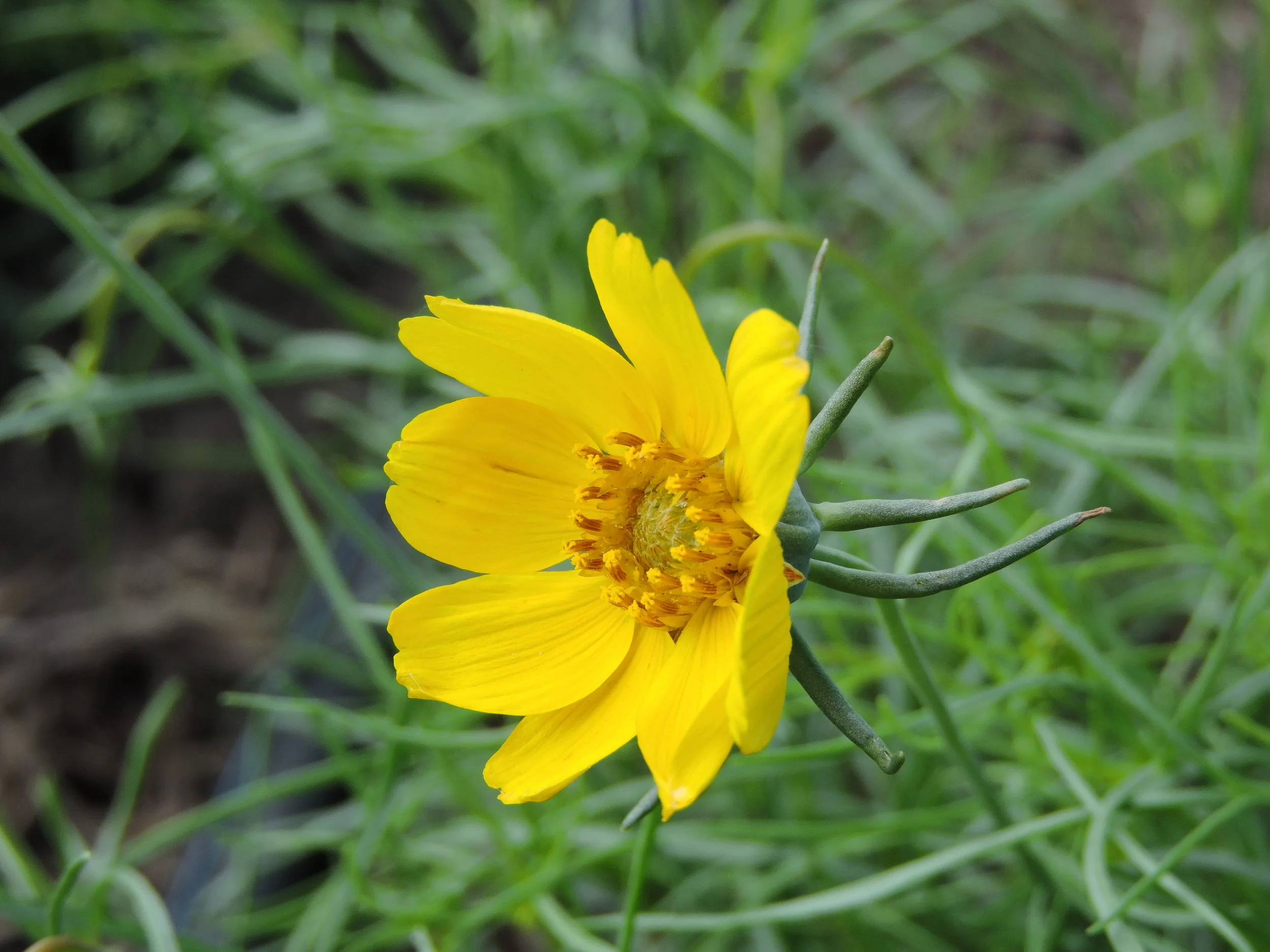
Thelesperma filifolium
You won't regret growing this! Greenthread, also known as Navajo Tea, is a beautiful North American native wildflower that attracts small native bees, and makes the most delicious herbal tea. Many species within the genus Thelesperma have been used by indigenous groups throughout North America for generations. For information about how to grow, harvest, and use greenthread, check out our blog post about it.
Greenthread is currently our only Slow Food USA Ark of Taste variety.
Packet: 50 Seeds

Ratibida columnifera
Drought tolerant perennial wildflower. This cultivar has deep red petals. Popular with small native bees.
The flowers of this plant can be used to get grayish purple through bluish sage on wool, and the leaves can be used to get earthy yellows/tans on wool. We had some interesting ecoprint results on cotton: Purple from the flowers, and bright yellow from the leaves/stems.
Start seeds indoors or direct sow autumn through spring. This species readily self-seeds.
Packet: 100 seeds

Tagetes lucida
This lovely herb native to Mexico and central America is often called Mexican mint or Mexican tarragon, as the leaves can be used as a tarragon substitute in cooking. Our seed crop didn’t have enough time to mature last season, so the seeds we are offering this year are from our friends at Wild Garden Seed (harvested from a perennial patch that James planted when he worked there years ago 🤗).
The entire plant can be used to dye natural fibers rich golden colors, and has a long history of use across its native range. We love to using the fresh plants for eco-printing, and dried plants for immersion dyeing. If you like the smell of licorice or tarragon, you’ll love the smell of this dye bath.
Start seeds indoors 6-8 weeks before your last frost date. They are perennial in zones 8-10, but we’ve had success overwintering some in 7b. Otherwise, plant as an annual. At the end of the year, cut back the entire plant to dry for future dye baths!
Packet: 100 seeds

Ocimum basilicum
Lovely purple/red basil that makes for a beautiful pop of color in your favorite dishes that call for sweet basil. The edible flowers are the perfect garnish for summer salads or pastas.
You can also dry or press the leaves and flowers for beautiful blueish-purple eco-print dyeing on mordanted natural fibers.
Start the seeds 6-8 weeks before your last frost, and transplant after danger of frost has passed. Seed prefer warm soil for germination.
Packet: 100 Seeds

Rheum sp ‘Victoria’
This excellent flavored rhubarb has green stalks with a slight red blush. The roots can be used for dyeing natural fibers tans, grays, and reddish browns depending on mordants and modifiers used.
Start harvesting stalks in the second year. Seeds can be direct sown in spring, or started indoors and transplanted after danger of frost has passed. After the plant is established, you can take root divisions in early spring for dyeing and replant the crown.
Packet: 50 seeds
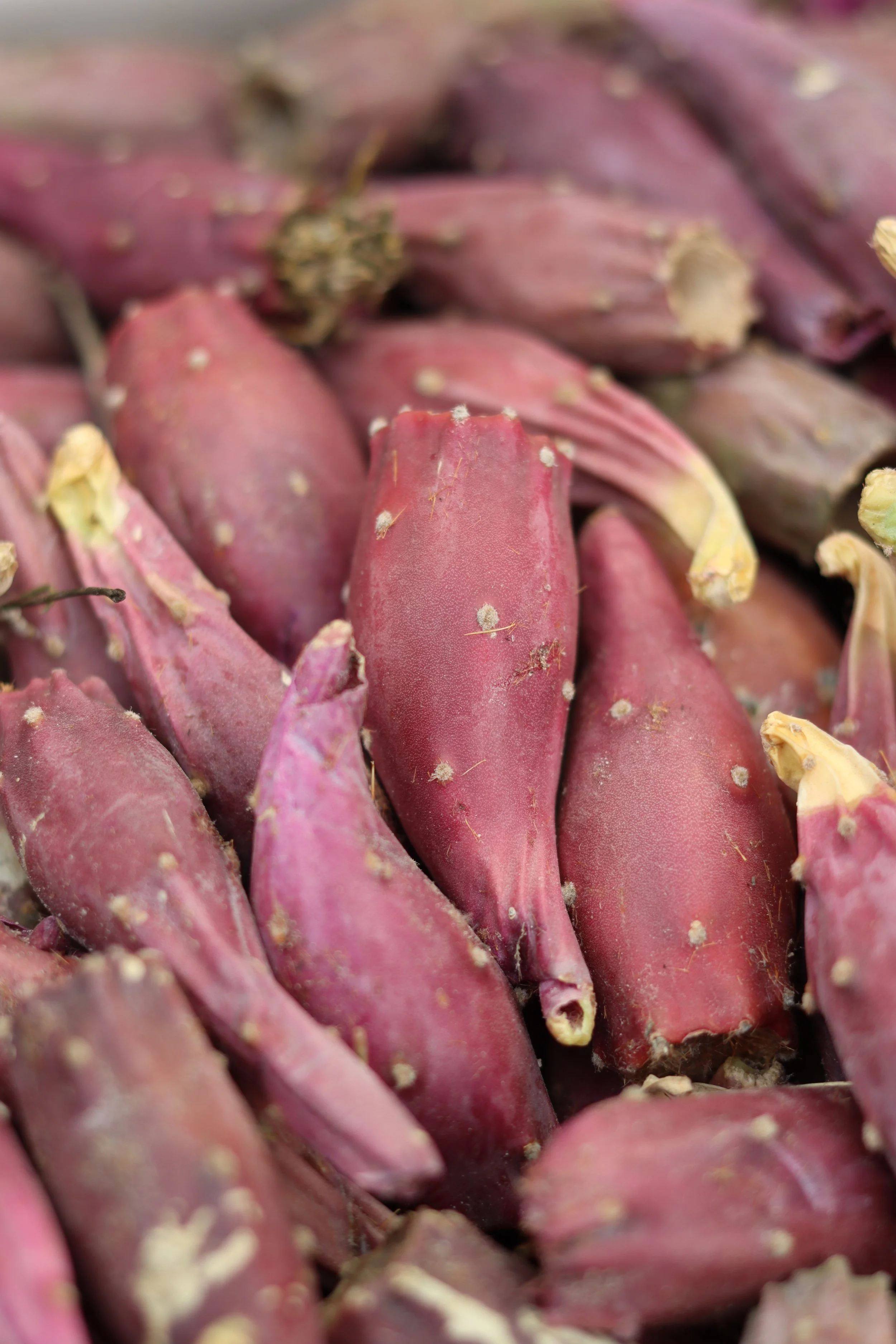
Opuntia macrorhiza
This hardy cactus species also known as plains prickly pear, western prickly pear, and big root prickly pear, is native to much of the United States and parts of northern Mexico and southern Canada, thriving in USDA hardiness zones 3-9. Preferring dry prairie conditions and rocky bedrock exposures, Prairie Prickly Pear is an excellent choice for rock gardens, xeriscapes, and low-water landscapes. It forms dense mats and produces vibrant yellow flowers with a striking reddish-orange base.
During the winter months, the plants may appear to dry down significantly and often lie flat against the ground, but rest assured, they are not dying! They are simply concentrating antifreeze-like compounds within their pads to protect themselves from freezing temperatures and prevent their pads from breaking open.
Growing Instructions:
For faster and more uniform germination, cold stratify the seeds before planting. However, we’ve had great success starting our Opuntia seeds on heat mats in a well-draining soil mix without stratification. Simply cover the seeds with a thin layer of soil. Germination typically takes 2-4 weeks.
When transplanting, choose a location that is south or west facing, with full sun and good soil drainage. Once established, plants can start producing fruit in 3-4 years.
Harvesting & Dyeing:
To harvest the fruit for dyeing, collect fully ripe fruits in autumn. Place them in water and store them at room temperature to ferment for 4-7 days. For quicker fermentation and better extraction, gently crush the fruits with a large rock (wear gloves to protect your hands from the tiny spines!). As the water becomes saturated with deep magenta betacyanins and thickens slightly, strain out the fruit pulp over a cloth to catch any glochid spines and plant debris.
If you're concerned about spines, you can skin the fruits before fermenting or burn off the glochids. Once the fruit is strained, place mordanted wool into the room temperature dye bath. Let the wool soak until the desired shade is achieved—this usually takes about 5 days, with gentle massaging of the skein at least once a day. While the deep purple shade isn’t as lightfast as cochineal, logwood, or a madder/indigo combination, it holds up well when not exposed to constant sunlight.
Packet Contains: 30 seeds
Herbs

Matricaria recutita
Grow your own soothing chamomile tea!
Direct sow seeds after last frost, or transplant seedlings after frost. Seeds require light for germination, so gently scatter them on the soil’s surface. They take 10-14 days to germinate.
These seeds were harvested from a beautiful insectary strip grown by Top Crops farm.
Packet: 200 seeds

Allium schoenoprasum
Chives are a classic perennial garden herb in the Amaryllis family that are related to onions. In the Middle Ages of Europe these plants were called ‘rush leeks’ due to their resemblance to grass-like rush plants.
Chives form 1 foot tall clumps of narrow, tubular, green foliage with mild onion flavor. The flowers are also delicious and make a colorful addition to salads, stir-fries, and garnishes. You can infuse vinegar with the flowers and other herbs as desired to make a savory rosy-colored condiment.
The flowers of our chives, like most, are a fresh rose-pink tone and form a dense ‘cloud’ of starry, sea anemone-shaped flower heads. The plants will bloom throughout your growing season if you keep the flowers deadheaded while they are still fresh and before they form seeds.
Chives are tough plants native to grasslands and open country of the northern latitudes of Asia, Europe and North American. They are adaptable to many growing conditions from drought to high moisture, full sun to mostly shade, rich to poor and heavy to light-textured soils. Chives tolerate very cold and fairly hot conditions; USDA cold hardiness zones 3-10.
They will be most productive for you in full sun with regular moisture and some fertility and drainage to the soil.
You can harvest the leaves a little at a time or do periodic cut backs close to the ground to harvest the whole plant and stimulate new growth as long as the growing season allows. Chives make a wonderful addition to ornamental plantings and are a great nectar and pollen provider for pollinators. They also do well in patio pots. Chive clumps can be divided periodically and given compost to boost growth. The tiny chive bulbs under the soil are easily replanted to make new clumps. Be sure to weed grass and other plants out of your chives to keep them from getting taken over as they grow in the same place for many years.
The strong sulfur compounds in chives and other onion relatives act as a repellent to a number of garden pests. The juice of the leaves can be used in making a home-made repellent for insects and other plant eaters as well as in the treatment of some fungal pests.
Packet: 100 seeds

Allium tuberosum
Also known as Chinese chives or Chinese leek, this native of Southwestern China is a great perennial addition to herb gardens. Once established, they are low maintenance and highly productive. As the name suggests, the leaves have a garlicky flavor opposed to the more onion-like flavor of common chives (Allium schoenoprasum). The gorgeous edible flowers make this a great ornamental plant as well. Plant indoors a few weeks before the last frost, or outdoors after danger of frost has passed.
Packet: 75 seeds

Salvia officinalis
This variety of Mediterranean garden sage has many culinary uses and has been selected for a higher essential oil content enhancing its flavoring and medicinal uses. Garden sage has traditionally been used as a brain enhancing tonic and to aid in digestion. It’s a wonderful addition to tea blends. Salvia species are also excellent nectar plants for honeybees and other pollinators.
Extrakta sage is very drought tolerant once established and is evergreen to at least zone 5. They bloom in long spikes of lilac and purple flowers in midsummer. You can get them to repeat blooms with deadheading and occasionally with adequate moisture and nutrition in the fall.
Garden sage performs best with plenty of light, drier or at least well-draining soils, and good air flow.
These beautiful plants take well to a light shearing to rejuvenate leggy growth, and they add a good structural component to your herb garden.
Seeds germinate quickly with warming soils (mid to high 60 degrees F), consistent moisture and a thin covering of soil or starting mix. They can be direct sown or transplanted. Keep seedlings in cool conditions as they can become heat stressed when young.
USDA hardiness zones: 4-10
Packet: 50 seeds
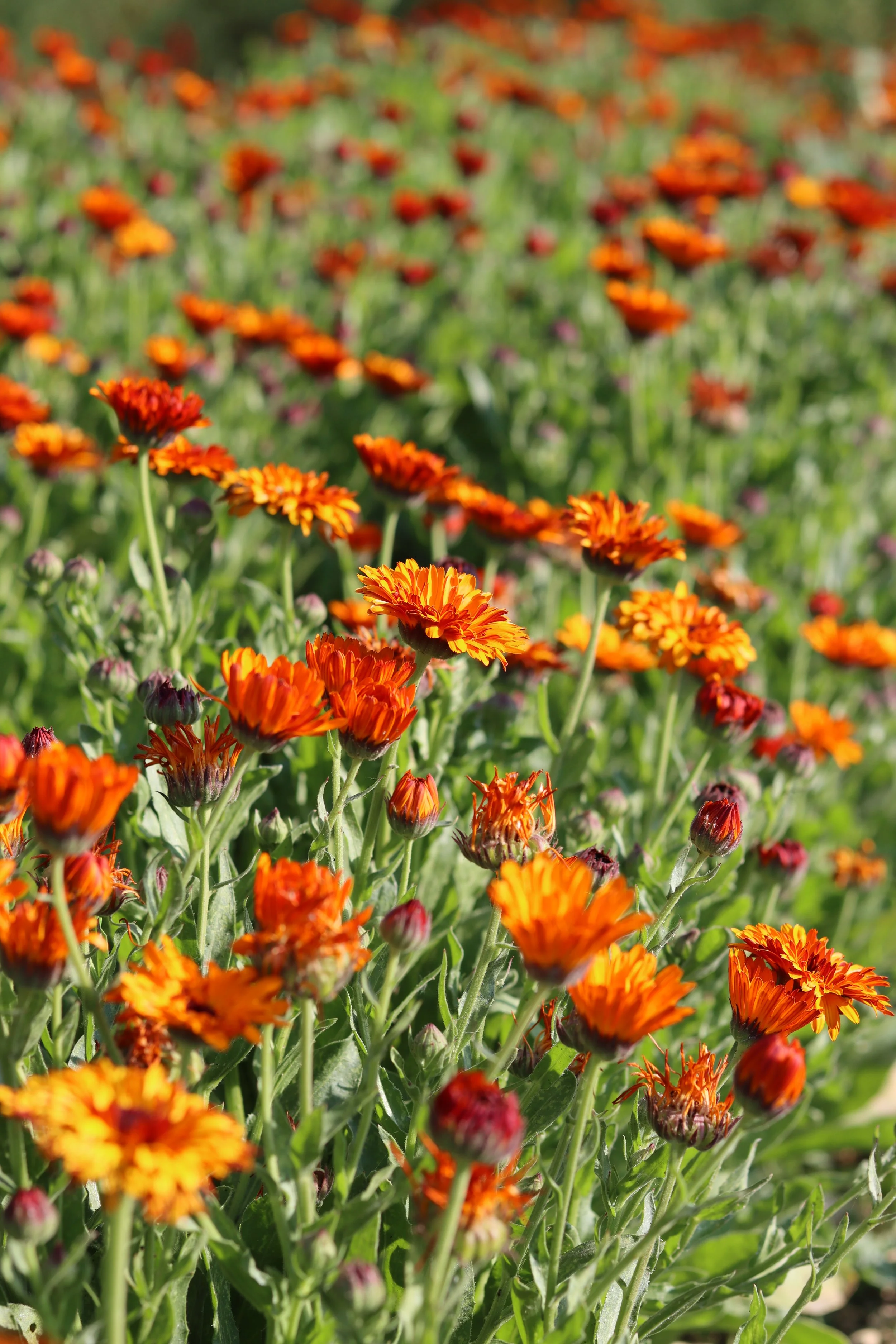
Calendula officinalis
This is one of Frank Morton's farm original varieties (and a pledged OSSI variety). We love how his description of the variety fits with the name so well, so we thought we'd include his words here: "From the Double Flashback gene pool, a solid head of orange petals with those showy red backsides. Flowers close together at sunset, gathering together into a 'barrel' shaped of crimson staves. In the morning, the orange-filled insides spill forth as the 'barrel' splits open again, day after day."
Packet: 50 seeds

Silene vulgaris/Silene Inflata
Even if this herb wasn't tasty, which it is, we would be growing this plant for its wonderfully whimsical flowers. During the day honey bees can be seen disappearing into the balloon-like flowers, and at night in our region the sculpit patch turns into a soft fluttering cloud of moths. A native of the Mediterranean, the mild-flavored tender leaves and shoots are traditionally used in pasta dishes, risottos, and omelettes. Start indoors before last frost date.
Packet: 150 Seeds
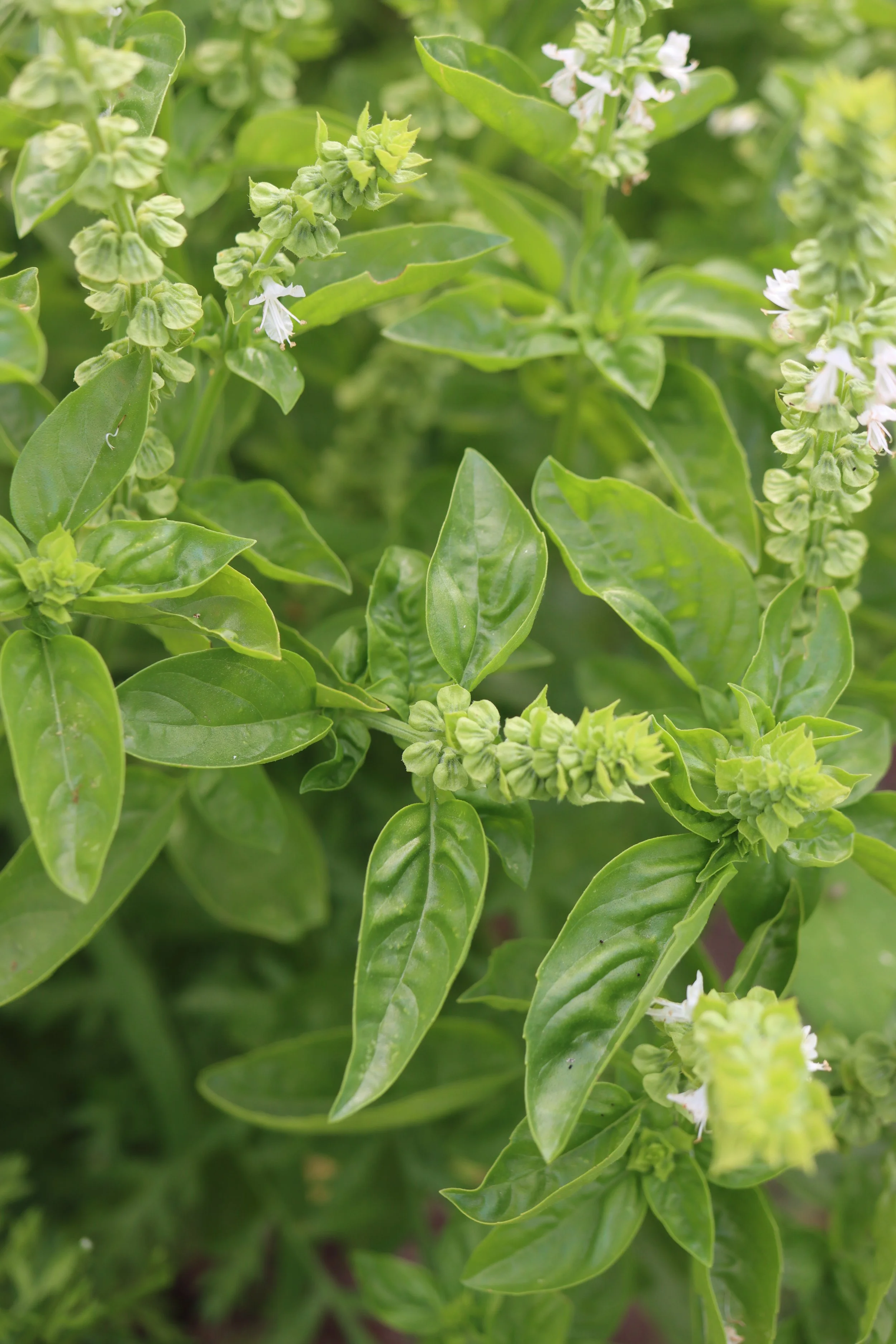
Ocimum basilicum
This classic sweet Italian basil is ideal for pesto, and the flowers make a delicious edible garnish.
Start indoors 4-6 weeks before last frost, or direct sow in late spring or early summer.
Packet: 100 seeds
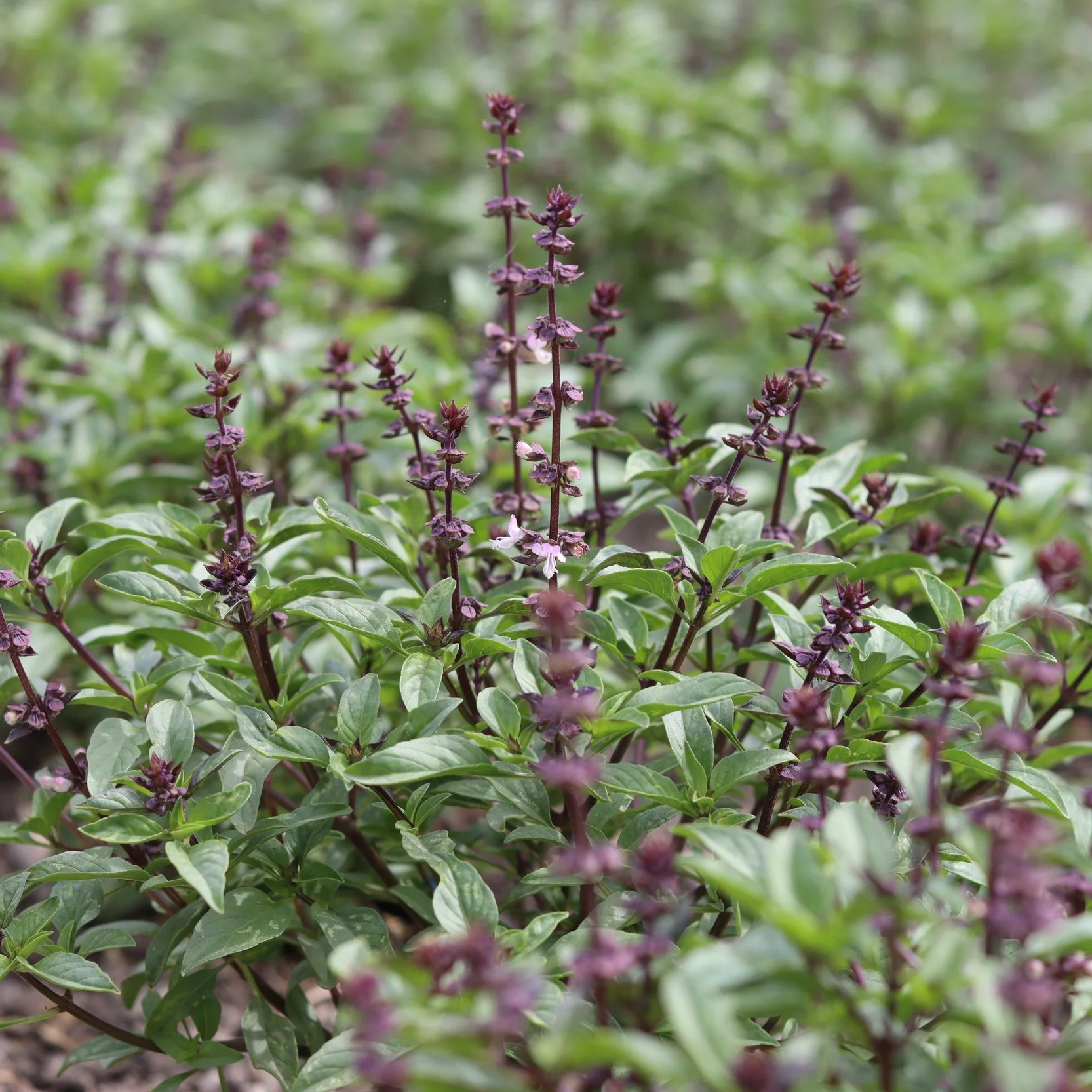
Ocimum basilicum
One of our favorite herbs for summer cooking, Thai basil brings a bold, distinctive flavor that is perfect for summer stir-fries. The aromatic leaves are complemented by delicate flowers, which make a beautiful and edible garnish.
Transplant after the danger of frost has passed, or direct sow in early summer.
Packet: 100 seeds

Ocimum africanum
This temperate species of Sacred Basil is a little more forgiving than the tropical Ocimum tenuiflorum. We became infatuated with this variety while James was working for Wild Garden Seed and would come home smelling heavenly after an afternoon of harvest or threshing. Wild Garden Seed acquired their starter seed from Abundant Life Seed in the early 1980s, and have been propagating it ever since.
We like to use it fresh in salads, or dried for use as a relaxing herbal tea. Mix it with dried butterfly pea flowers or black magic bachelors button flowers to make a tea that looks as fruity as it tastes ❤.
Seed Packet: 300 seeds

Anethum graveolens
This is a great slow-to-bolt bunching dill with gorgeous lacy greens. When it does bolt, it creates large umbels that are great for your pickling projects.
Our friends at Top Crops grew this crop for its greens, and let us know when there was a beautiful crop of seed for us to harvest. They appreciated how many times they could cut back this variety for bunching.
We recommend direct sowing in early spring, but you can also start indoors 3-4 weeks before your last frost date. It can take 7-21 days for germination.
Packet: 200 seeds
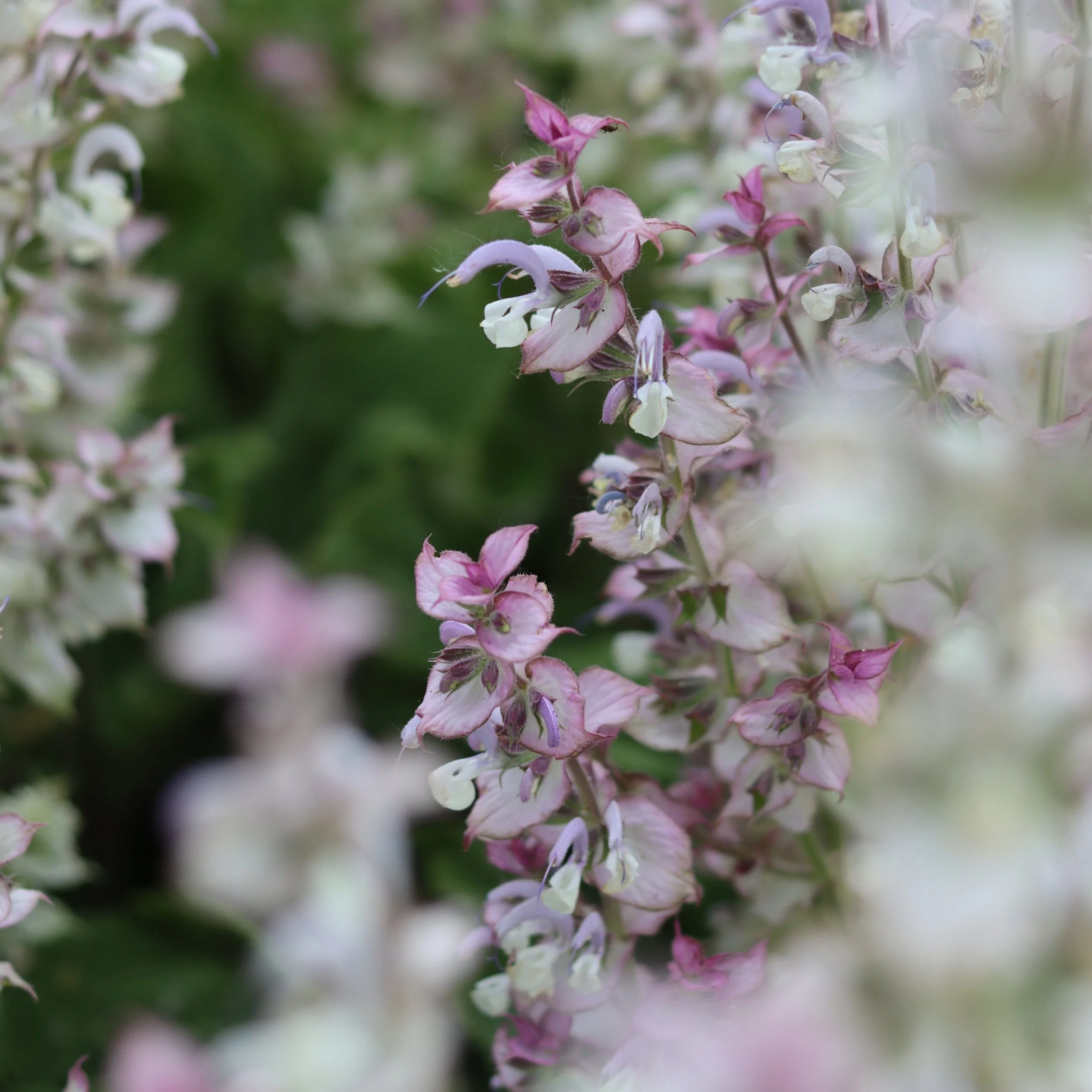
Salvia sclarea
This striking perennial from the mint family boasts a unique and captivating scent, making it an excellent choice for planting near your patio or any other spot where you spend a lot of time in your yard. It also attracts a wide variety of pollinators.
Salvia sclarea is commonly used in aromatherapy and in popular ingredient in perfumes and liqueurs.
For planting, sow seeds directly in early spring, covering them lightly with soil. Thin the seedlings to about 1-foot spacing. The plants grow in clumps, forming a rosette in the first year, followed by vibrant blooms in subsequent years. USDA zone. 5-9.
This seed was grown by our friends at the Mobile Moon Coop.
Washington State Residents: Clary sage is considered a noxious weed in your bio region and will not be shipped to your state.
Packet: 100 Seeds

Agastache rugosa
This purple flowered perennial is one of our favorite herbs for making tea. The flavor is somewhere between licorice, tarragon, and mint, with a wonderful amount of natural sweetness. You can use leaves fresh or dried.
Direct sow seeds in early spring, or start indoors and transplant after your last frost. We surface sow the seeds, or just barely as they prefer light for germination. Thin plants to 1 foot spacing.
This OSSI variety was bred by Frank Morton of Wild Garden Seed.
Packet: 300 Seeds

Levisticum officinale
Lovage is a robust perennial herb with a bold flavor similar to celery, but more savory and complex. It’s a fantastic addition to soups, salads, and dressings, bringing depth and richness to your dishes. Guy especially loves making a zesty sauce with garlic, olive oil, lemon juice, and lovage to drizzle over white fish. The hollow stems of the leaves and flower stalks also make excellent, flavorful straws for a Bloody Mary!
For planting, sow seeds 1/8–1/4” deep. Germination can take 2-3 weeks, and because of occasional dormancy, it’s a good idea to sow a few extra seeds to ensure a successful start. We recommend transplanting your seedlings after the danger of frost has passed, spacing them about 2 feet apart, as the plants can grow quite large after their first year.
Packet: 150 seeds
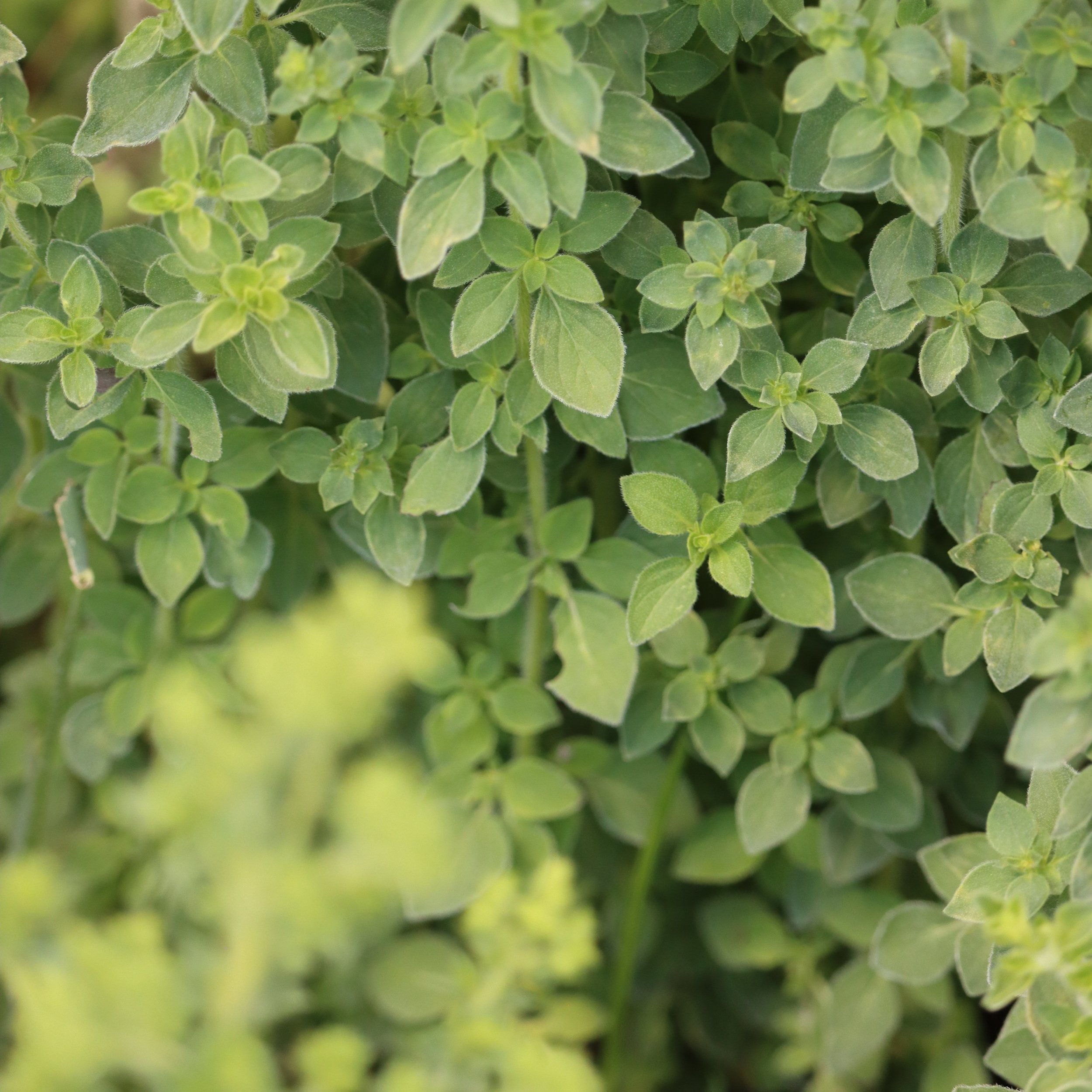
Origanum vulgare hirtum
This flavorful oregano is a must-have for any herb garden. Its plants can be trimmed multiple times throughout the season, and you can enjoy the herb both fresh and dried. The tiny white flowers are also edible and make a charming garnish for pizza, soups, and pasta dishes.
For best results, transplant seedlings after your last frost. Since the seeds are tiny and require light to germinate, surface sow them in flats. Once ready, transplant the seedlings 1 foot apart in your garden. Plants can grow up to two feet tall.
The seed for this variety comes to us from our friend Chris at Rustling Aspen Farm in Midway, Utah.
Packet: 200 Seeds

Nigella sativa
Black seed, AKA black cumin, Roman coriander, Nigella, kalonji, zeera or black caraway.
An annual summer blooming herb in the buttercup family with white, light yellow or pale blue flowers. They have an interesting claw shaped flower pistil, which is the central female part of the flower that later becomes the dried and inflated seedpod. Our flowers are the pale blue variety.
Does well when seeded directly into the garden in the fall or early spring but easy to start in flats or pots. Thrives in regular garden soil and full sun, but can handle part sun with poor soil as well. Black seed resembles its relative Love-in-a-mist (Nigella damascaena), with feathery foliage and simple flowers growing up to about a foot tall. Loved by bees!
Wait to harvest seed until the seedpods are quite dry but keep an eye on them as they start to split open so you can catch the seeds before they get dropped. Plant a good number of plants (30+) in the spring, provide regular water and some compost for a good harvest.
Black seed enjoys great renown and a considerable history of cultivation and use in traditional Arab and African medicines stretching back to ancient Egypt and there is a substantial body of current scientific research exploring the many medical/nutritional aspects of this plant. Search pubmed.gov with “nigella sativa” and you’ll find that since 1964 over 650 peer-reviewed studies referencing it have been published.
Traditionally used for indigestion, appetite loss, parasites and inflammation. It was found in Tutankhamen’s tomb, which suggests they thought he would need it in the afterlife. The prophet of Islam Muhammed is believed to have said that “It is a remedy for all diseases except death.”
It is starting to be recognized in the west as a super food for its high content of beneficial compounds.
Consumed as an oil or seed, either internally or topically, used as a condiment, all in small amounts. I like to grind and blend it with black pepper, or throw it in loose-leaf chai tea blends. Experiment with the flavor and see what you like.
Black seed has a high content of thymoquinone, thymohydroquinone and thymol, naturally formed compounds with powerful anti-viral and anti-bacterial activity.
Other compounds that it contains are nigellone which inhibits histamine release and may help to reduce allergy symptoms. Interestingly the seeds are very high in melanin. It is a different form than the melanins that color our skin, eyes, hair and is found throughout our nervous systems (neuromelanin) and in other parts of the body. Melanins in plants and animals have a strong antioxidant property that is part of photo-protective and chemo-protective (guarding against light and chemical damage) roles. (Adila El-Obeid et. al wjpls, 2016, Vol. 2, Issue 1, 147-153)
Black seed shares some common names with an unrelated species Bunium bulbocastanum in the carrot family whose roots, leaves, and seeds are also used as condiment or confection and called black cumin or black caraway.
Superfood!
Medicinal
Bee-loved!
Easy!
Packet: 100 seeds
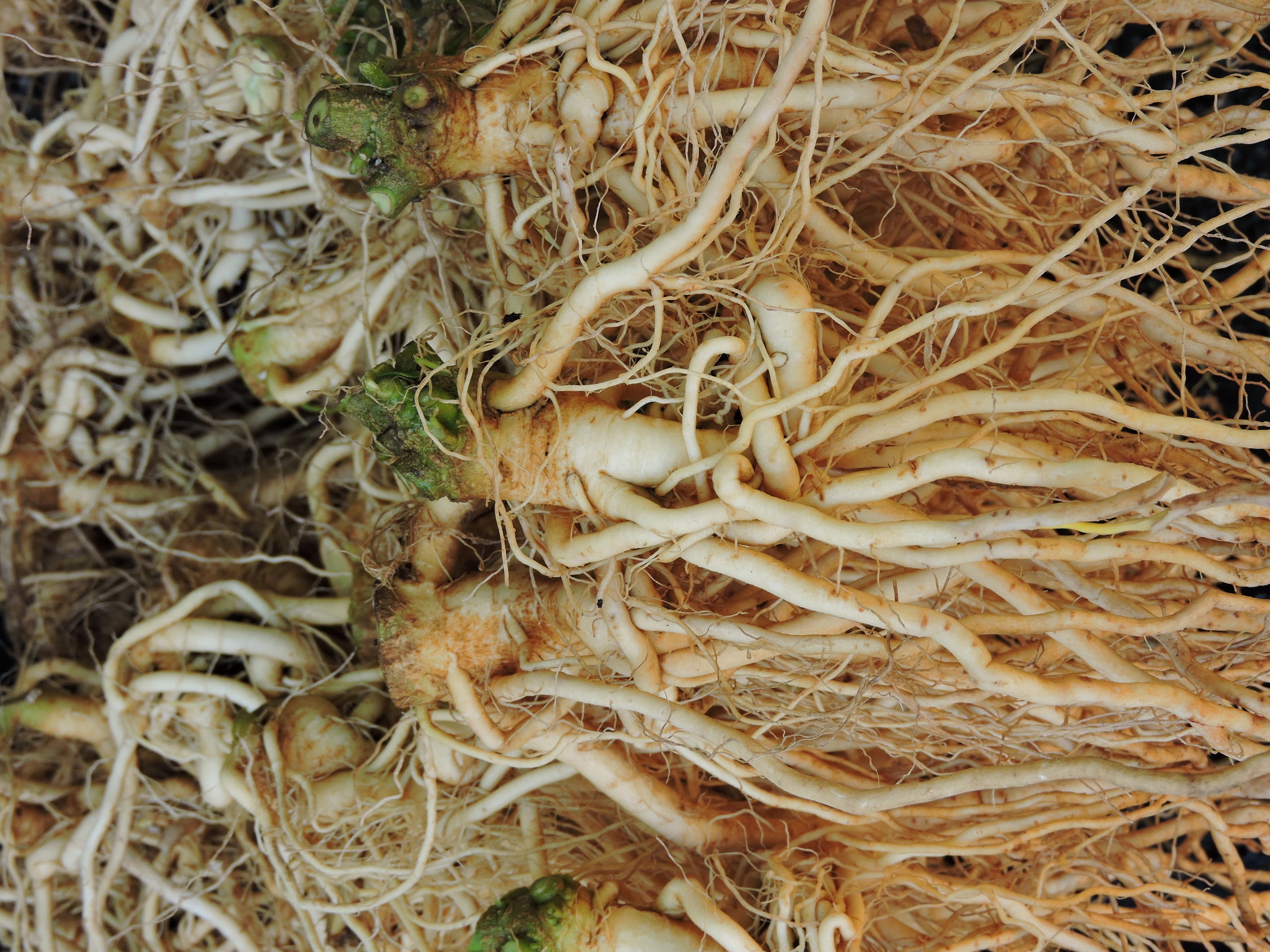
Withania somnifera
Thought to originate from the Indian state of Rajasthan, Ashwagandha is a tropical shrub grown in cooler temperate zones as an annual forb. It has a long and widespread history used as a medicinal plant or superfood. In both the traditional Ayurvedic medicine of India and the Traditional Chinese Medicine (TCM) the roots are used as an adaptogenic herb. Adaptogenic herbs assist the body in dealing with the many stresses of life by supporting hormone balances, nerve function, and gland health. The seeds can be used as a vegetable source rennet for cheese making.
Packet: 100 seeds

In 2026, 50% of online sales ($2.25 from every packet) for Hopi Nicotiana, Hopi Red Dye Amaranth, and Hopi Black Dye Sunflower will be donated to Hopi Tutskwa Permaculture. We are excited to support their work around food sovereignty through this indigenous seed benefit sharing partnership. Below is some information about their non-profit from their website. For additional information and ways to support their work, click here.
About Hopi Tutskwa Permaculture
Hopi Tutskwa Permaculture is a community Indigenous-led non-profit based in the village of Kykotsmovi, located in Northern Arizona on the Indigenous Hopi Reservation. Our mission is to create community-based solutions in order to pass knowledge to future generations and rebuild culturally sustainable and healthy communities. We initiate learning projects that engage, train, and inspire Hopi youth and community to revitalize Hopi culture, knowledge, and traditions. We support Hopi community members in developing leadership skills to strengthen local food systems and to implement sustainable ecological projects within the Hopi community. We aim to provide our community with the tools, training and practical experience needed to rebuild a vibrant community based on traditional Hopi values and worldview.
Hopi Nicotiana
Nicotiana rustica
Ceremonial and ornamental nicotiana. The flowers are a lovely lemon-lime color, and the plants are far more resilient and forgiving than other species of Nicotiana that we've grown in the past. The high levels of alkaloids in this variety make it a great ingredient in organic pest deterrents. Start indoors before last frost, and be patient as they can be slow to germinate.
Packet: 200 Seeds

Ruta graveolens
This evergreen perennial is a larval host plant to multiple species of swallowtail butterfly. The beautiful blue-green foliage is lovely filler in floral arrangements, and can be harvested throughout the year in our region. The seed pods are gorgeous in dried arrangements.
Direct sow seeds in late winter or early spring, or start indoors and transplant in early spring. Once established, it is exceedingly drought tolerant.
Like parsnips, carrots, figs, and citrus, common rue can cause phytophotodermatitis in some individuals with sensitive skin. If you have sensitive skin, or a history of developing rashes when coming into contact with plant oils, make sure to wear gloves when working with common rue. Most people are not affected.
Packet: 100 seeds
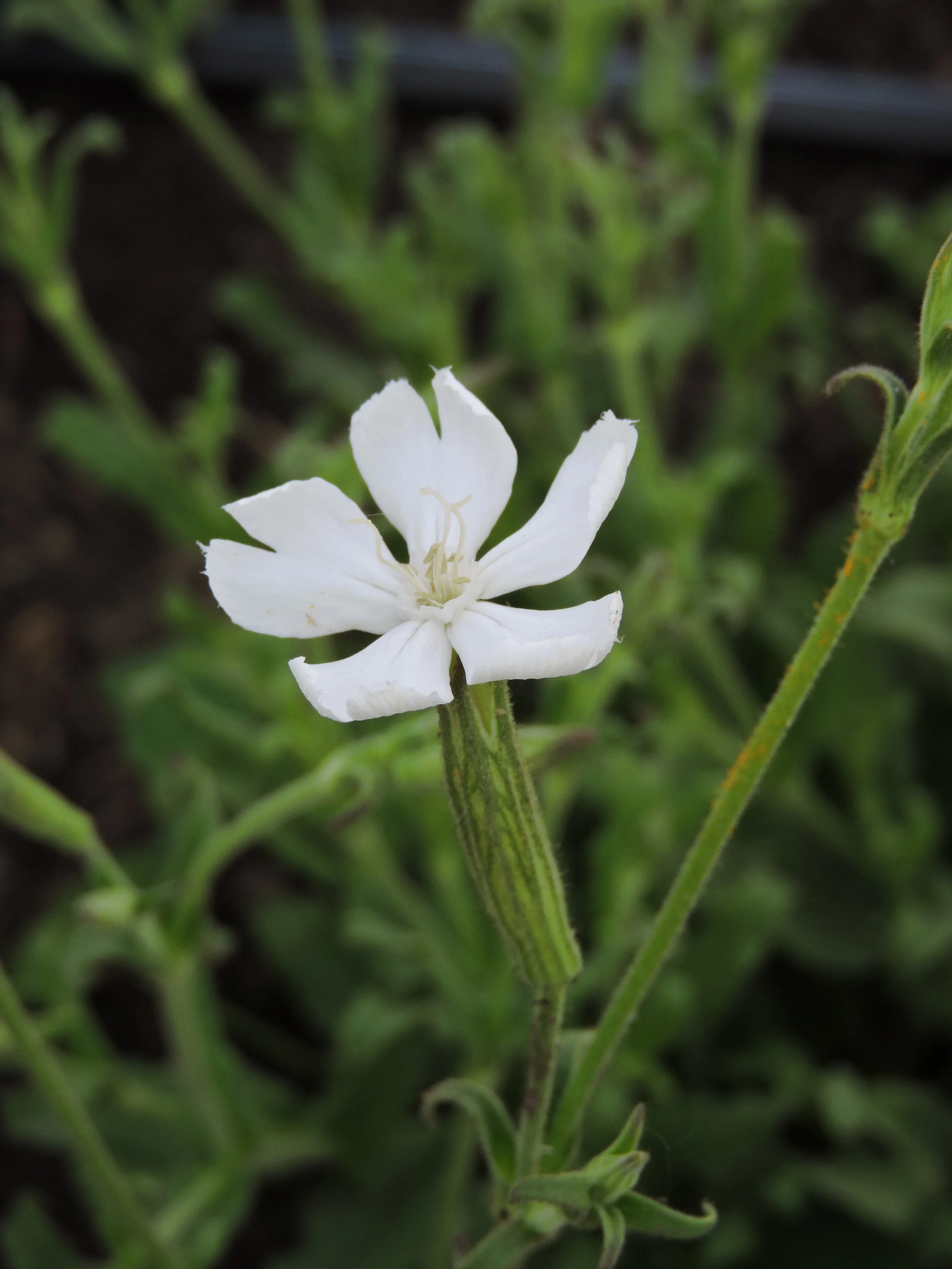
Silene capensis
A heat tolerant and somewhat drought tolerant wildflower native to the eastern cape of South Africa. It forms a rosette of narrow leaves and can bloom with its white flowers up to 2 feet tall. It seems to be hardy to at least a zone 7 (10 F) in an unprotected pot, but I think it will overwinter in zone 6 in the ground with some mulching (testing winter 2017-18). It can also be grown as an annual. Occasional trimming of the tops during active growth can stimulate root development. Kelp tea or other mild micronutrient and mineral rich fertilizers with some potassium content are good for supporting root development.
Dreamroot is a type of catchfly (silene), and like many of them it has sticky stems and sepals near the flowers that can catch small insects, this is thought to protect flower parts from being eaten by ants. Inevitably honeybees and other innocent bystanders get caught in its defenses. Perhaps it doubles as a way to collect nutrients that will feed the roots when fallen stems, leaves and captured insects decompose around the plant.
A traditional oneirogen (dream-stimulating) and emetic (purging) herb of the Xhosa people and others in the Eastern Cape of South Africa, it is used to enhance lucidity and prophetic dreams. Xhosa is a click language and the ‘xh’ is pronounced by lightly pressing the tip of the tongue to the roof of your mouth near your front teeth, and making a slight suction to release it while you are making a vowel sound. Here is an interesting bit of trivia: it is thought by some, that the vibrations of click languages can affect/stimulate activity of the brain’s pineal gland, found near the sinuses. The pineal gland actually has a calcite/hydroxyapatite crystal that can be affected by the two forces of piezoelectricity (direct; electrical charge produced through compression of certain minerals including calcite, quartz and crystalline matrices in bone and converse; compression of crystals by electromagnetic frequencies). There are some interesting scientific articles on the topic of "piezoelectricity and the pineal gland".
Traditional preparation: The Xhosa prepare S. capensis by powdering the roots, which they call undlela ziimhlophe (which translates to ‘white paths’ or ‘white ways’), and drinking the powder with water on an empty stomach.
Germination: Start dreamroot seeds much like tomatoes. Keep the seeds warm, 70-75 degrees F, moist and pressed lightly into a good quality potting soil or compost. Be patient as they can take some time to sprout.
Packet: 30 Seeds
Native plants

Argemone munita
This poppy is extraordinarily tough and drought tolerant. It can be seen re-sprouting after fires in the Southwest when no other vegetation survives. Within an irrigated garden, the plant flourishes with a heavy bloom load that goes all summer until the first frost. The flowers are an incredibly crisp white that forms the perfect backdrop to observe native pollinators.
Sow seeds in spring or autumn. Without smoke or fire treatment some plants will sprout, but there will be some built-in dormancy. To achieve a higher rate of germination, you can start a small smoky fire with pine needles or straw above your seeded area. After the fire burns out, spread the ashes and water them in. Some people have had success buying all-natural smoke flavoring from supermarkets, diluting it with 10 parts water and soaking the seeds in the solution before sowing. If you are starting seeds in flats, you can periodically pass smoky branches underneath. Plant in a well weeded area, and be patient for germination. The seedlings look slightly "weedy", so check out the seedling photo on the left for identification.
We currently have two seed options for Argemone munita. You can choose between seed that was grown on our farm (4780' elevation with lots of supplemental water), or for those interested in specific seed transfer zones, we have some ethically harvested seed from Juab and Sanpete Counties in central Utah (5,500' elevation in pinyon-juniper shrub land that receives very little rainfall).
Packet: 200 seeds

Oenothera caespitosa
Tufted evening primrose, desert evening primrose, fragrant evening primrose.
A beautiful mound-forming, fragrant, night-blooming perennial wildflower that prefers fast-draining sandy or rocky soils in a wide range through the central and western United States. There are many subspecies so it can vary in appearance as you move across its native range. The original seed source for the plants we grow is from plants found on the foothills of the Wasatch Mountains in Northern Utah, and the marginata subspecies.
Tufted evening primrose is a great low-water option for rock gardens, patio pots, raised garden beds, and suitable landscaping areas.
The large, silky, white flowers open in the evening to attract pollinators overnight and as the following day warms up, the blooms will typically turn pink and wither. The flowers last a little longer in mild temperatures and in less sunny conditions. We grow a few plants in pots on our front porch so that we can enjoy the beautiful scent when we are relaxing at home on summer nights.
Tufted evening primrose is a larval host plant for the white-lined hawkmoth (Hyles lineata) which is a native moth in much of the Western United States. The soft fuzzy leaves have a crinkly, toothed margin and remain evergreen in at least USDA zone 5 winters (temperatures drop to -20 to -25 degrees F). In very dry conditions the leaves will drop and the plant will go dormant. It is a low-growing plant that can form clumps up to 3 feet wide and 1 foot tall in the right conditions.
These plants can bloom in the first year from seed. Tufted evening primrose may be short-lived (2 years) but the average lifespan is typically much longer. Providing adequate drainage in the soil, at least a half day of full sun, and allowing soil to dry in between waterings should keep these plants happy for years. If the leaves look wilted it’s time to water.
Seeds will have optimal germination if they receive 8-12 weeks of cold stratification before planting, but a percentage of seeds will germinate without stratification.
Packet: 50 seeds

Ipomopsis rubra
This wildflower is a native of a large area from North Carolina to Texas. It prefers well draining soil. Plant indoors a few weeks before the last frost date, and then transplant to 1' spacing. You can also direct sow in autumn for blooms the following summer. They are biennials, so they typically bloom their second year, but ours managed to bloom during their first season here in Utah. We planted ours in flats in mid-March, transplanted in April, and had blooms by late July. We’ve also had success sowing them between snow storms in late February.
If you cut down the first flowering stalk when it has finished blooming, the plant will be encouraged to send up more flowers.
On multiple occasions we saw flowers detach from the plants as a hummingbird would back away after drinking nectar, leaving the birds with a little flower tube stuck to their beaks. #cuteoverload
Packet: 200 seeds

Solidago missouriensis
An Aster family (Compositae) perennial wildflower with a large range across North America’s moist and dry prairies. It grows in full sun to part (light) shade. These plants are clumpers with some limited spread by roots and they grow up to 3 -5 feet tall depending available moisture and nutrients. The plants are heavy feeders, and will benefit from a spring and/or fall topdressing with compost.
Prairie goldenrod are crowned with flower heads of hundreds of small golden yellow flowers in late summer through fall that attract butterflies and other pollinators and beneficial insects. These plants can have colorful fall foliage and their rigid, upright structure can provide some winter interest even in a snowy garden. Goldenrods are great habitat plants because their late summer to fall bloom period make them a valuable nectar and pollen resource for beneficial insects and honeybees. Self-sows readily, cut off flower heads or strip fluffy seeds after bloom to prevent windblown seed drop. To make room for new growth in spring or to rejuvenate an old stand, cut stems to the ground in the fall or in the spring with the additional ecological benefit of overwintering habitat for stem nesting pollinators and beneficial insects.
When doing spring cutback for overwintering habitat, wait for non-freezing night time temperatures to allow for emerging insects etc. to find safe conditions. Alternatively you can cut stems, loosely bundle them and place them in a ‘bug hotel’ area or out of the way place for safe emergence in warmer conditions.
Young leaves are edible fresh or as a potherb, but may not have the best flavor, a nicely flavored tea can be made from flowers and leaves. Goldenrod has been used traditionally for its diuretic, anti-inflammatory and anti-allergenic traits among others.
Goldenrod has been called a common allergen but this claim has been discredited and the misconception is largely due to the shared bloom time with ragweed. Goldenrod pollen is too heavy to be wind-borne and is carried by insects.
USDA Hardiness zones: 3-8
Seed can be planted in spring or fall, cover very lightly or surface sow, and keep moist until germination, or spread outdoors before a period of moist soil conditions and non-freezing conditions. Germination typically occurs in 1 to 2 weeks.
Packet: 200 seeds (Because of the difficulty of cleaning goldenrod seeds, there will be lots of chaff in the packet of this variety. Over seed as germination can be sporadic!)

Prunella vulgaris var. lanceolata
A beautiful, perennial native wildflower in the mint family, found in moist to somewhat dry areas of woodlands, meadows, prairies and wetlands up to 8,000 feet elevation in our region. Several closely related subspecies are widespread across the northern hemisphere. These bloom in cone-like heads of deep purple flowers. They will sprawl and self seed when available moisture and ‘disturbed’ or available bare ground is available. This variety has somewhat larger flowers and narrower, lance-like leaves than the even more widespread Eurasian subspecies (Prunella vulgaris). Bloom time is from mid spring to early fall depending on available moisture, nutrients, and sunlight. Deadheading or harvesting flowerheads before seed set can also prolong bloom time.
This plant is a great pollinator plant, small cut flower, edible potherb and has many uses in western herbal traditions and Traditional Chinese Medicine. Many of its traditional medicinal uses are being borne out by scientific research as the biological activity of its rich chemistry is further investigated. Selfheal shows multiple properties such as: anti-microbial, anti-cancer, and anti-inflammation among others 1).
Traditional medicinal applications include: topical poultices of the macerated leaves and stems for wounds, and rashes, teas of the leaves, flowers and seed heads for a wide range of treatments.
The leaves and flowers are also edible fresh in a salad or as a potherb, they have a fresh, slightly bitter taste and a demulcent quality, probably best eaten in moderation or in a mix with other greens. These plants are known to concentrate lead so do not forage them from roadsides and be careful of potentially contaminated soils in the home landscape.
Moist to dry growing conditions, full to part sun. Adaptable to a wide range of soil conditions. These plants can be grown as groundcovers, as part of a turf, they will still bloom on short stems with mowing. They also are an excellent addition to pollinator and beneficial insect plantings, habitat plantings for birds and insects and meadow plantings. The seeds or ‘nutlets’ are enjoyed by a variety of seed eating birds. These plants are a good pioneer species for habitat enrichment in prairie, meadow and wetland restorations due to their ability to establish quickly and compete with weeds.
Perennial in USDA hardiness zones: 4-9
Evergreen in milder conditions.
Seed germinates without a cold treatment. Can be direct sown into prepared ground in spring or fall. Long term stands of these plants benefit from occasional disturbance such as: raking, tillage, fire, flood, gopher, soil turnover, etc. to provide fresh ground for seedlings.
Packet: 100 seeds
Citation:
1). Wang SJ, Wang XH, Dai YY, Ma MH, Rahman K, Nian H, Zhang H. Prunella vulgaris: A Comprehensive Review of Chemical Constituents, Pharmacological Effects and Clinical Applications. Curr Pharm Des. 2019;25(3):359-369. doi: 10.2174/1381612825666190313121608. PMID: 30864498.

Solidago velutina
An Aster family (Compositae) perennial wildflower native to the arid Western United States. These plants are adaptable, low water plants with a spreading habit and leaves with a velvety coating that is more pronounced in different subspecies and populations as a water saving adaptation.
Velvety goldenrod sends up flower spikes from 1 to 3 feet tall, topped in yellow gold plumes of small flowers in mid to late summer through fall. Secondary flowers bloom on a single side of their stems often creating an arcing habit. In drier natural habitats the plants grow into low loose clumps several feet wide, spreading by slender rhizomes. They grow taller an denser when in wetter conditions and they spread further in looser soils.
Like most if not all goldenrods, these flowers provide important nectar and pollen to native bees, honey bees, butterflies and other beneficial insects and creatures late in the season when many floral nectar sources have finished. As an ornamental plant, these bring color to the garden or meadow as most blooming slows down.
Goldenrod has been used traditionally for its diuretic, anti-inflammatory and anti-allergenic traits among others.
Goldenrod has been called a common allergen but this claim has been discredited and the misconception is largely due to the shared bloom time with ragweed. Goldenrod pollen is too heavy to be wind-borne, it is carried by insects.
Plant in full sun to part shade.
Wet to dry soils.
Note: As with most drought tolerant plants, these seedlings must get regular water until the roots are established enough to survive in dry conditions.
Propagate by seed or division.
USDA hardiness zones: 5-10
Seed can be planted in spring or fall, cover very lightly or surface sow, and keep moist until germination, or spread outdoors before a period of moist soil conditions and non-freezing conditions. Germination typically occurs in 1 to 2 weeks.
Packet: 200 seeds (Because of the difficulty of cleaning goldenrod seeds, there will be lots of chaff in the packet of this variety. Over seed as germination can be sporadic!)

Asclepias incarnata
We just love these perfect pink and white flowers 💕, and the monarchs seem to prefer them to the other species of milkweed we grow.
Swamp milkweed is native to much of the United States and Eastern Canada. Like narrowleaf milkweed, swamp milkweed often blooms in its first year. It prefers moist soil, but can perform well in a moderately watered flower garden.
Cold stratifying the seeds for 4-6 weeks can aid in germination, but we’ve had luck starting them without stratification. You can also direct sow your seeds from autumn through early spring, and wait for them to germinate on their own schedule. Consider planting them near a rain spout to take advantage of extra water throughout the growing season.
The form we cultivate comes from northern Utah.
Packet: 30 seeds

Asclepias speciosa
A beautiful, spreading, perennial wildflower with wide, blue-grey-green leaves. When mature the plants can grow up to 5 feet tall in the right conditions and they produce abundant globes of enchanting, pink, fragrant, star-shaped flowers from summer into fall. Those flowers provide nectar and pollen for a broad spectrum of butterflies, bees, hummingbirds, and other pollinators.
Showy milkweed is also an important host plant to Monarch butterflies like Common milkweed, Swamp milkweed and other species. The caterpillars eat the leaves, pods and tender shoots of the plants; as they eat they concentrate distasteful alkaloids from the milky sap of the plants that makes them bad-tasting and toxic to would-be predators.
Showy milkweed has many gifts; it is less toxic than many of its cousins, the young pods are tender and edible when pickled or cooked, the latex (milky sap) has been used historically to treat warts topically, and the fluff from the seedpods has been used to line footwear among other uses.
Showy milkweed thrives in moist soils but its deep taproot allow it to tolerate drought well. Grow the plants in a sunny spot for flowers and you can expect to see a large patch develop over time. Best to provide ample space and avoid planting next to plants that don’t like competition. A Native plant from Western and Central Canada all the way to Mexico.
Seeds should be sown in the fall or winter, or cold stratify in the refrigerator 1-2 months to direct sow in spring or start seeds indoors.
Packet: 30 seeds

Asclepias fascicularis
Narrowleaf Milkweed is a beautiful, drought-tolerant, perennial wildflower native to many of the western states. The flowers are like a smaller version of common milkweed flowers and have a color range of greenish-white to rose-pink. Our seed stock are the contrasting white and dusty rose version. The plants bloom from early summer into the fall and more lushly with supplemental water.
They grow as a 3x3 foot clump with upright stems, long narrow leaves and many clusters of flowers. Prefer full sun to part shade and winter hardy to at least USDA zone 6.
A host plant to the majestic Monarch Butterfly and charming Red Milkweed Beetle and provider of pollen and nectar to many other pollinator species. The Red Milkweed Beetle’s scientific name is tetraopes tetrophthalmus which translates from ancient greek to four eyes four eyes because the beetle’s antennae developed to grow in the middle of what were once single eyes splitting two to make four. Ethnobotany: Narrowleaf milkweed is a traditional cordage plant, you can twist the long fibers from the dead stems to make a strong, thin line. The seed fluff makes a great moccasin/slipper liner as well!
For more information on milkweed species of the Great Basin, check out this great PDF that was put together from a partnership between the Xerces Society, NRCS, USDA, and Monarch Joint Venture.
Packet: 30 Seeds

Asclepias asperula
Beyond being a favorite nectar source for native pollinators, this clump-forming perennial milkweed is a showstopper with its unique purple and green flowers. Upon seeing a bud open, you will likely become possessed by a talent show judge, and exclaim one of the following things:
“I don’t like it… I LOVE IT!”
-Paul Hollywood, The Great British Baking Show
”YOU ARE ON THE HOT TAMALE TRAIN!”
- Mary Murphy, SYTYCD
”DING DONG darling!”
- Val Garland, GLOW UP
Antelope horns milkweed is native to many states west of the Mississippi, and is commonly found on sunny slopes with well drained sandy or rocky soil. Once established, they are very drought tolerant. Direct sow seeds in autumn, winter, or early spring, or start indoors after cold stratifying the seeds in a refrigerator for 3-4 weeks. Some individuals may bloom the first year, but they often start blooming after their first winter.
The form we grow comes from the Wasatch Range in northern Utah.
Packet: 30 seeds

Penstemon palmeri
We asked some of our plant enthusiast friends to describe Palmer’s penstemon in one word, and their responses confirmed our suspicion that Palmer’s is the Celine Dion of penstemons: Colossal, sirenic, statuesque, majestic, flamboyant, perfumed, whimsical, and flashy.
Palmer’s is much taller than most penstemon species, often reaching 4-5’, and is unique in that it is extremely fragrant. There were so many summer evenings where I should have been weeding, but instead sat in our penstemon patch taking photos of native bees, and basking in the beautiful cotton-candy scent. The plants are evergreen, and winter often brings out a beautiful pinkish-purple color in the stems that is a beautiful contrast to the blue-green leaves. The flowers are voluptuous bumble-bee enveloping blooms in gentle pink with magenta streams cascading from the floral tube onto the lower lip.
This species is native to the arid West, and prefers well draining soils. It will suffer if you over-water or provide too much fertilizer. They are short-lived perennials that are great at self-seeding. Rake seeds into soil from autumn through winter to allow the seeds to get cold stratification before spring. Some individuals will bloom the first year, but the majority will bloom in their second year.
Packet: 400

Penstemon strictiformis
A perennial native wildflower from the arid four corners area of Colorado, Utah, Arizona, and New Mexico. Mancos Penstemon is frequently confused with Rocky Mountain Penstemon (Penstemon strictis) due to overlap in visible traits in some populations. Many penstemons cross readily with a number of other species including Penstemon strictis and Penstemon strictiformis.
This is a great low-water pollinator plant, with vivid purple to blue flowers that are attractive to diverse native bees, flies, wasps, bumblebees, and European honeybees.
This plant forms slowly spreading clumps of emerald evergreen leaves that take on russet to purple tones in cold conditions during the fall and winter. They can give a lush look to low-water gardens.
These plants form beautiful 1 to 3 feet tall spikes of blue to purple tubular flowers for weeks in mid-spring to mid-summer. Bloom time is generally a few weeks but length is dependent on conditions. Provided adequate sunshine, cooler and or wetter conditions will support a longer bloom, and the stress of hotter and or drier conditions can shorter the bloom.
Plant in sun to light shade and avoiding dense plantings. Penstemons or beardtongues generally prefer drier conditions, good soil drainage and lower nutrients. They will live longer in these conditions because, they have a tendency to ‘bloom themselves to death’ with nutrient rich soils and regular moderate water. They will generally rot and die with excessive moisture so proper siting and soil that is drier or drains water more quickly are important.
Sow directly into outdoor/unheated greenhouse planting beds, pots or flats in late autumn through early spring for the seeds to receive cold stratification so that they will sprout. For direct sowing prepare soil by moving aside any thick mulch and roughing up the surface of your soil for direct contact.
Packet: 400 seeds

Anemopsis californica
Anemopsis is a monotypic genus with californica being its sole species. In its native range (Southwest United States and Mexico), yerba mansa prefers wet soils in hot arid landscapes, but also grows beautifully in a moderately watered garden if given full sun. It forms a deep taproot, which allows it to become seasonally drought tolerant. When happy, it will form above ground runners which will quickly fill in open garden space.
The roots have antimicrobial properties, and have been used in traditional medicine to treat everything from athletes foot to yeast infections. The entire plant is very aromatic, and can be used in natural potpourri mixes.
Germination is heat dependent, and can take several weeks. Start your seeds indoors on a heated seed starting mat, and then transplant seedlings outdoors after your last frost date. They can be successfully grown in container gardens.
Packet: 200 seeds

Proboscidea parviflora
A unique and lovely annual plant in the Sesame family native to the Southwestern US and Northern Mexico that has multiple uses and good drought tolerance.
The plant has rosy colored stems and sticky, trichome-covered leaves, stems and flowers that can capture small insects, probably providing protection against attack from small sap-suckers and leaf eaters. Devil’s claw has beautiful, tube-shaped, pink, magenta, yellow and white flowers that are a little reminiscent of foxglove flowers with interesting markings and are attractive to native bees.
The pods develop into long, curved shapes, and as they dry out they split down the middle, making pointed ‘claws’. The claws allow the seedpods to catch a ride on creatures so that their seeds can be spread far and wide. It is thought that these plants evolved alongside large creatures of the ancient Americas, getting their seed dispersed by animals like ground sloths and ancient horses.
The plants are heliotropic, meaning that they move to follow the sun like the flowers of sunflowers, but in Devil’s claws’ case the entire plant follows the sun. It’s fascinating to see!
The edible protein- and oil-rich seeds, peeled roots, and young pods have a long history of use by many Southwestern tribes. The strong fibers of the woody, black claws of the mature pods are used in creating contrast in beautiful basketry patterns seen in the works of the Tohono O’odham and other peoples of the Southwest. The women of some of these groups have been selecting Devil’s claw for edibility and basketry for many generations. We enjoy decorating our home with the most unusual claws from each plant; their elegant lines look like organic calligraphy.
Our original seed stock that we grew our crop from was wild-collected white-seeded plants near a wash in Washington County, Utah. According to Native Seeds/SEARCH materials, the white-seeded plants make bigger pods and the seeds of those plants were typically collected and propagated in breeding the domesticated versions of these plants.
To assist seed germination, peel off the seedcoat and sow seeds when the soil has warmed. The plants do well with full sun and dry soils, and they thrive in heat and summer moisture that mimic southwestern summer monsoons.
Packet: 20 seeds

Mentzelia decapetala
Tenpetal blazingstar, evening-star, evening starflower, candleflower, gumbo lily, chalk lily
A native, drought-tolerant wildflower found in Utah and the central states. It has a spectacular display of large, yellow-centered, creamy-white flowers that resemble cactus flowers. Through the summer they open their flowers in the evening and close before morning. They can also open in overcast weather and attract many nighttime pollinators like moths and possibly pollinating bat species in the desert Southwest. We saw bees trying to get at the still closed flowers around dusk on many occasions. The flowers smell like honey! Makes a great moon garden plant alongside sacred datura and evening primrose.
Tenpetal blazingstar is a biennial to short-lived perennial wildflower with a long taproot and it can be found growing in dry areas, quick draining soils and slopes on harsh, full sun, exposures like road cuts and skree slopes and can be surprisingly lush looking for its harsh environs. The plants can grow to a few feet in height and width and have interesting toothed leaves with a rough texture.
The plants tolerate consistent watering as long as they have some drainage and a chance to dry out a bit and enough sun. Direct seeding in the fall or early spring is best so the plants can develop their long taproots, but they can be started in flats or pots as long as you plant them out before they stunt themselves in small containers. Cold stratification aids in germination.
Drought-tolerant!
Night-evening blooming!
Pollinators!
Utah native, we have found it in North and central Utah!
Packet: 200 seeds

Phacelia campanularia
An annual wildflower hailing from the desert Southwest, these striking, deep purple/blue flowers bloom prolifically from spring till frost. They tolerate drought and can take hot and dry conditions but will bloom much longer and grow larger if they receive consistent, low watering. The plants will even survive a few dips into freezing and keep blooming in the fall. Like many wildflowers of the southwest and California deserts they have an interesting smell that isn’t the typical sweetness. Desert bluebell flowers have a sweet but peppery aroma and they produce a steady and plentiful supply of nectar and pollen that bring in a wide array of pollinators.
Direct seed in fall, or early spring through summer, or start in flats in the green house with strong light and plant out before they start blooming. They will be stronger and more drought-tolerant if direct seeded or planted as small starts. These plants naturalize well in warm to hot summer areas if allowed to drop seeds.
Full to part sun.
Very low to medium water
Pollinator magnet!
Packet: 250 seeds

Clarkia pulchella
This vibrantly colored, annual wildflower has a striking and unique antler shape. Its native distribution ranges through the northwestern states from South Dakota to British Columbia in Canada. Named for Captain William Clark of the Lewis and Clark expedition, it grows up to a foot and a half tall and can be un-branched or widely branching, and blooms from late spring to mid-summer. Like its cousin Lindley’s clarkia, the leafcutter bees enjoy using its petals for lining their nest tubes. Attracts bees and butterflies. Elkhorn Clarkia is a resilient steppe and grasslands plant with wide soil tolerances and can handle drought and some crowding.
Direct seed in fall, or early spring through summer, or start in flats in the green house or with plenty of light and plant out before they start blooming. They will be stronger and more drought-tolerant if direct seeded or planted as small starts.
Full to part sun
Low to medium water
Packet: 200 seeds
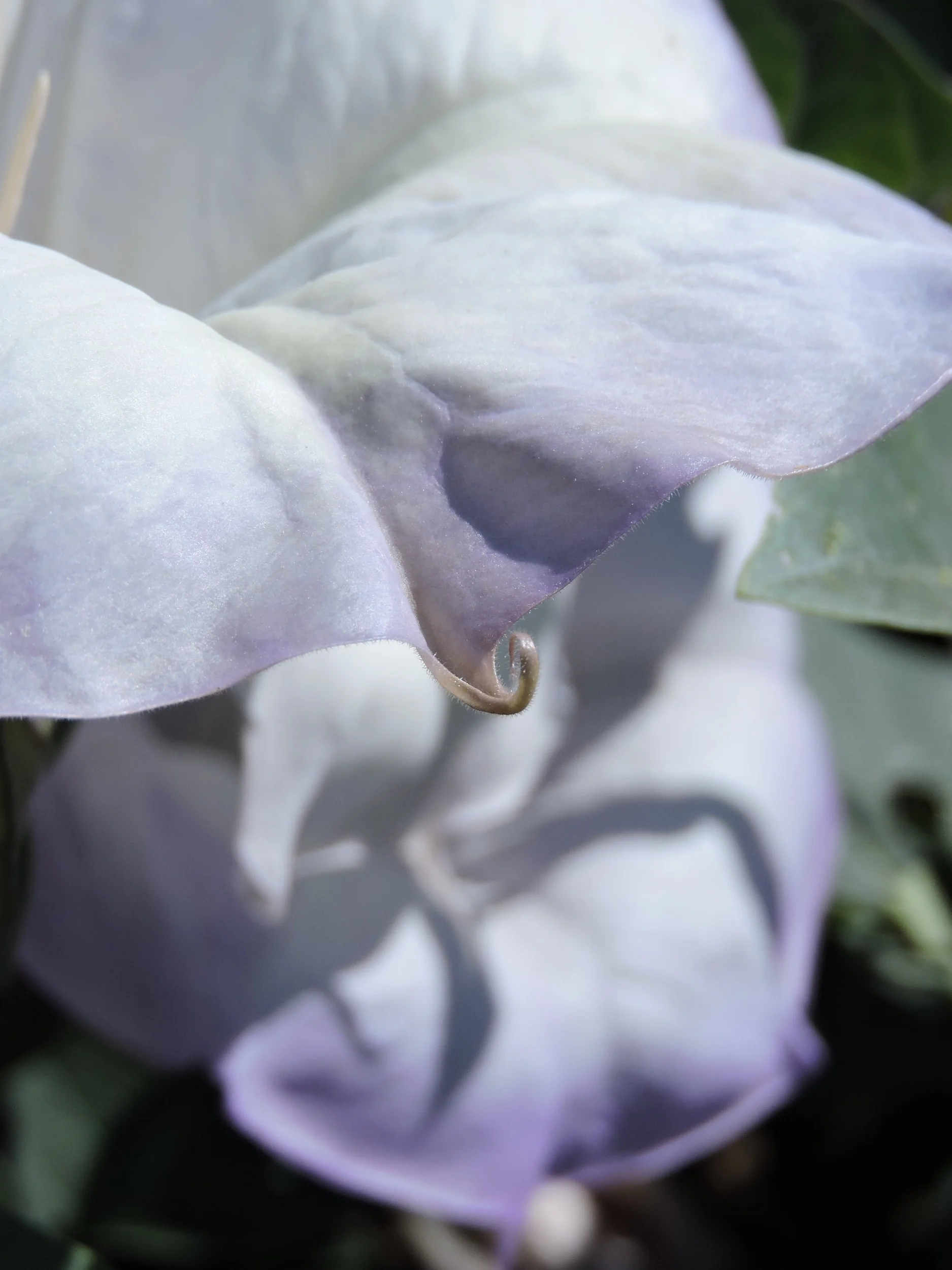
Datura wrightii
Our sacred datura seed is a mix from plants we encountered in northern, central, and southern Utah. Very diverse genetics and traits. Datura create massive blooms that open at night and close before noon the following day. They look incredible in moon light, and often attract sphinx moths. Sow seeds in late spring or early summer when soil temperatures are warm. Once established they are perennial down to zone 7 and very drought tolerant. All parts of the plant are toxic. Do not consume.
Packet: 100 seeds

Desmanthus illinoensis
A native plant of Southwestern Utah and the central states, perennial wildflower of grassy plains and other open sunny settings across the western states. Bundleflower plants are named for the way that their seedpods form together in a bundle; they are in the Pea family and closely related to mimosa trees. These 2-to 4-foot-tall plants have soft, ferny foliage, DMT-containing rootbark and small white globe-shaped flowers. Like most plants in the pea family (Fabaceae) they host Rhizobia bacteria in their roots that change atmospheric nitrogen into a form usable by plants. This creates fertility for themselves and nearby plants as the nitrogen enters the soil.
Illinois bundleflower is being studied for use as a perennial human grain crop by The Land Institute, an independent non-profit in Kansas working to mimic the natural processes of the prairies to create sustainable, ecologically appropriate, perennial food systems.
The flowers provide food for small nectar seekers, the foliage is enjoyed by herbivores and used in pasture mixes for forage, and the seeds provide food for quail, pheasant, prairie chickens and domestic chickens and rodents and potentially other creatures (do your homework). Bundleflower is also a good perennial for enriching your soil and compost through its nitrogen fixing capability and biomass productivity.
Direct sowing is best. If you do not scarify the seeds, sow them in the fall for winter conditions to break through the tough seed coat. Otherwise, scarify (see below) and sow in warming soils in the spring. You can start them in flats in the spring as well. Just make sure that you keep an eye on them and pot them up if roots start hitting the bottom of the cell; pot them up or plant them out to avoid stunted growth.
Seed germination is greatly enhanced by scarification. You can rub it between two pieces of sandpaper, make a small nick through the seedcoat, or tumble or shake it with coarse sand and then sow the mixture into your prepared seed bed. Bundleflower also benefits from inoculation with beneficial mycorrhizea (symbiotic root fungi) and root nodule forming, nitrogen-fixing Rhizobia bacteria (a standard bean and pea bacteria inoculum). These fungi and bacteria are often present in healthy living soils, and particularly the nitrogen-fixing bacteria may be present in high enough numbers where other bean family plants have grown.
Packet: 50 Seeds

Nicotiana attenuata
(We are currently sold out, but will have a fresh seed crop available in January 2027. Sign up for our newsletter at the bottom of the page for updates)
An annual plant growing up to up to 3 feet tall in ideal conditions. Coyote nicotiana offers a prolific display of long, tubular white flowers and will bloom continuously throughout the summer if provided with regular water. It tolerates long periods of hot and arid conditions provided it has some soil moisture.
This species ranges from British Columbia to Mexico in the western United States and lives in diverse habitats typically in drier and more open areas. As a disturbance species, we have see it springing up in large swaths were wildfires have been.
Hawkmoths and hummingbirds are its main pollinators. Coyote nicotiana has a fascinating relationship with two hawkmoth species; Carolina sphinx moth and the five-spotted hawkmoth, both of which pollinate the flowers at night while they drink nectar and lay their eggs on the plant.
When the plant cells detect the saliva of the hawkmoth caterpillars as they eat the leaves, the plant tissues set off a chemical cascade that shifts the bloom of the flowers to daytime when they will be pollinated by hummingbirds. This helps the plant to avoid attracting more hawkmoths and future consumption
This revered plant has a long history of relationship with many indigenous peoples of western North America, especially in ritual and medicine traditions.
These plants transplant well from starts and can also be direct sown mid to late spring.
Though very adaptable to wide-ranging conditions, coyote nicotiana, like most nicotianas, respond well to a side dressing with compost after they have taken root and started to grow to enhance lushness and profuse blooming.
Packet: 200 seeds
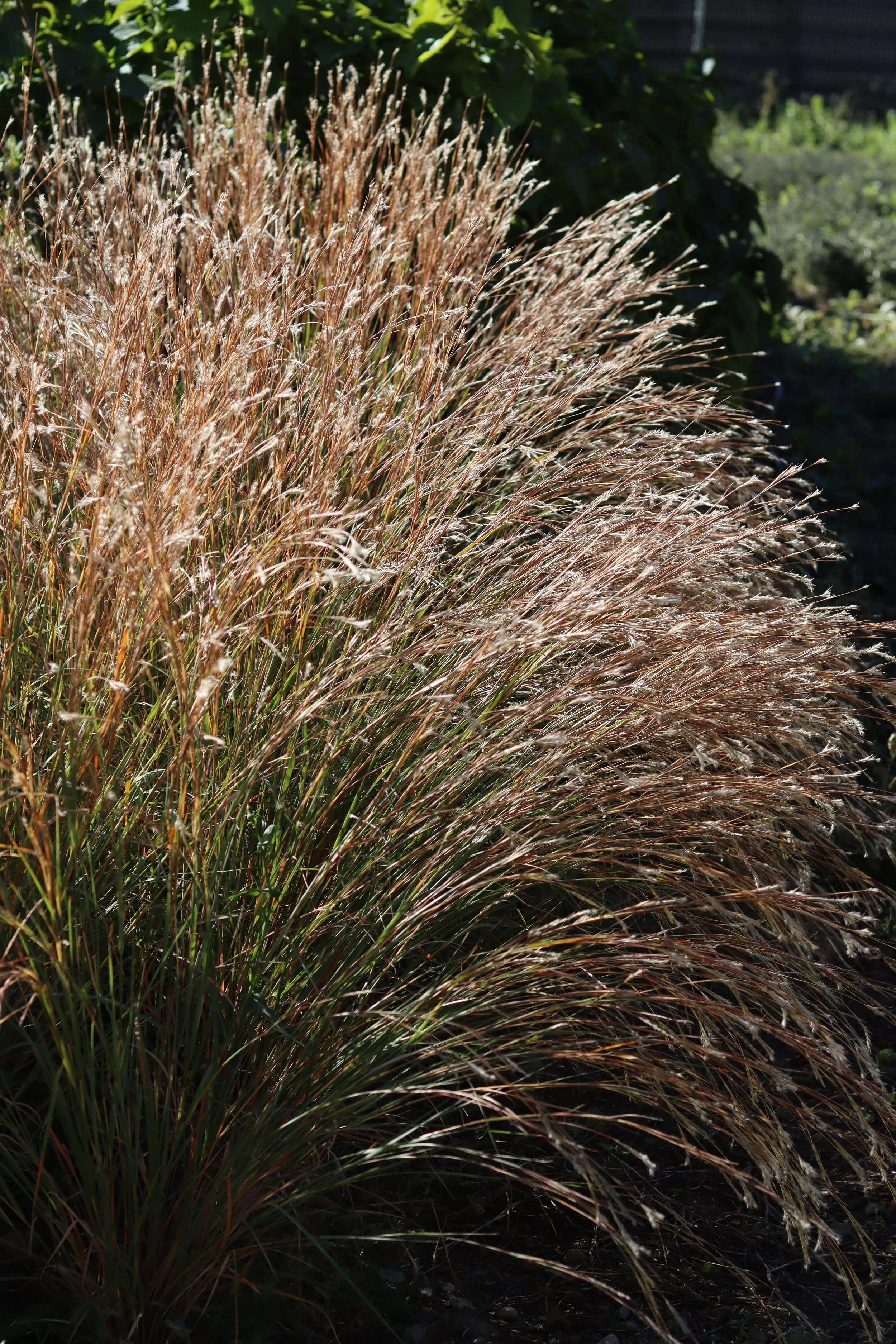
Andropogon gerardii
Big bluestem, tall bluestem, or turkey foot.
A lovely, color-shifting, US-native bunch grass, whose natural range extends from the East Coast into the eastern portion of the western States. The original seed source for the plants we grow is a native population in the southwestern tip of Utah.
The new spring blades emerge green-blue and start to turn coppery tones and then into purple and blue tones with the beginning of cooler temperatures in the fall. The white fuzz on the seed heads catches the light and contrasts beautifully with the fall colors of the rest of the plant. Big bluestem is a warm-season grass that can grow 4 to 6 feet tall in clumps spreading 2 to 3 feet wide. Warm-season grasses are dormant during cold seasons and begin active growth with the return of warmer temperatures.
This highly ornamental native grass makes a great addition to meadow plantings, wildlife plantings, and many styles of landscapes. The grass clumps provide excellent shelter throughout the year for beneficial insects, birds appreciate the seeds in fall and winter, and this grass is an excellent forage for livestock and wildlife.
Big bluestem is an adaptable grass that can live in dry to wet conditions. Drought tolerance will improve as the plant establishes a deep, strong root system. Continue regular watering for the first 1 to 2 years before decreasing irrigation.
Plant in full to part sun, and avoid excessive fertilizing which can cause weak growth and attract pests. Light compost application twice a year or less would be more than sufficient.
Big bluestem is an easy grass to maintain. You can shear back the previous year’s growth in the late spring to clear the way for new growth as warmer conditions return. Beneficial insects and pollinators benefit from leaving the stems up until warm conditions to allow them a safe place to overwinter.
Transplant or direct sow after danger of frost. We’ve had the best success by transplanting seeds that were started on a heat mat.
Packet: 30 seeds
Flowers

Zinnia elegans
Pink, rozë, arrosa, ружовы, roze, розов, rosa, roze, růžový, lyserød, roosa, vaaleanpunainen, rôze, ροζ , rózsaszín, Bleikur, bándearg, sārts, rožinis, розова, roża, różowy, roz, розовый , pinc, розе , Ružová, roza, rosado, алсу, рожевий ,pinc, ראָזעווע, վարդագույն, çəhrayı, পরাকাষ্ঠা, 粉 , ვარდისფერი, ગુલાબી, गुलाबी, liab, ピンク, ಗುಲಾಬಿ, қызғылт, ផ្កាឈូក, 담홍색 , кызгылт, ສີບົວ, പാടലവര്ണ്ണമായ, गुलाबी, ягаан, ပန်းရောင်, गुलाबी, ଗୋଲାପୀ |, ګلابي, ਗੁਲਾਬੀ, گلابي, රෝස, гулобӣ, இளஞ்சிவப்பு, గులాబీ, สีชมพู, pembe, gülgüne, ھالرەڭ, pushti, Hồng, زهري, וָרוֹד pembe, رنگ صورتی, pienk, ሐምራዊ, pinki, umutuku.
This zinnia mix is another word for pink 💕.
So many shades of pink, and so many zinnia bloom types are represented in this mix: cupcake, single, partially doubled, etc.
Start seeds indoors before last frost or direct sow when soils have warmed. Plant or thin to 1’ spacing. Plants get about 3’ tall, and have blooms that are about 2” wide. Zinnia’s are easy to grow, and they attract a wide range of pollinators including butterflies, native bees, and humming birds.
Packet: 40 seeds

Zinnia elegans
This heirloom variety has large blooms atop long stems, making it a great choice for arrangements. Excellent for attracting hummingbirds, bees, and butterflies to your garden!
Direct sow after your last frost date, or transplant after frost. They prefer full sun!
Packet: 40 seeds

Zinnia elegans
This mix was grown from off-types we found while growing oriole zinnia. We love the coral reds, oranges, and pinks in this mix. The long stems make it great for arrangements, and the blooms bring in a wide array of pollinators.
Zinnias are very easy to grow from seed. Start seeds indoors before last frost or direct sow when soils have warmed. Plant or thin to 1’ spacing.
Packet: 40 seeds

Amaranthus caudatus
This ornamental amaranth has luxurious cascading tassels that add beautiful movement to arrangements.
Direct sow seeds in late spring or early summer when soil temperatures have warmed. Thin to the strongest seedlings at 1’ spacing. You can also start indoors, and transplant after last frost. Plants typically get between 3-5’ tall.
Packet: 200 seeds

Digitalis lanata
This elegant foxglove has tall flower spikes covered with wooly cream-colored blooms. Typically a biennial, but occasionally blooms the first year. Direct sow in early spring, or start indoors and transplant after frost.
This foxglove is native to central and southern Europe.
Packet: 150 seeds

Consolida ajacis
Gorgeous mix of purple and white Larkspur with lacy foliage. These plants get 3-4’ tall, and are prolific bloomers. An excellent addition to a cut flower garden.
These seeds were harvested from an insectary patch at Top Crops Farm in Salt Lake City (where we grow a portion of our seed crops). The various color types in this mix are allowed to cross pollinate with each other, which makes each year’s crop unique.
Larkspur prefers cool weather for germination, so direct sowing seeds in early spring will provide you with a higher germination rate than starting indoors. Plants can self-seed readily in some climates, so make sure these aren’t invasive in your area before purchasing.
All parts of larkspur are toxic when consumed. Like many plants, use caution around pets, children, and livestock.
Packet: 100 seeds

Nigella orientalis
This Nigella species is so unique and delightful. Every stage from the bud to seedpod is so whimsical. The flowers are beautiful in fresh arrangements, and the dried pods are great in garlands, wearables, and dried arrangements.
They prefer to be direct sown early to mid-spring.
Packet: 50 seeds
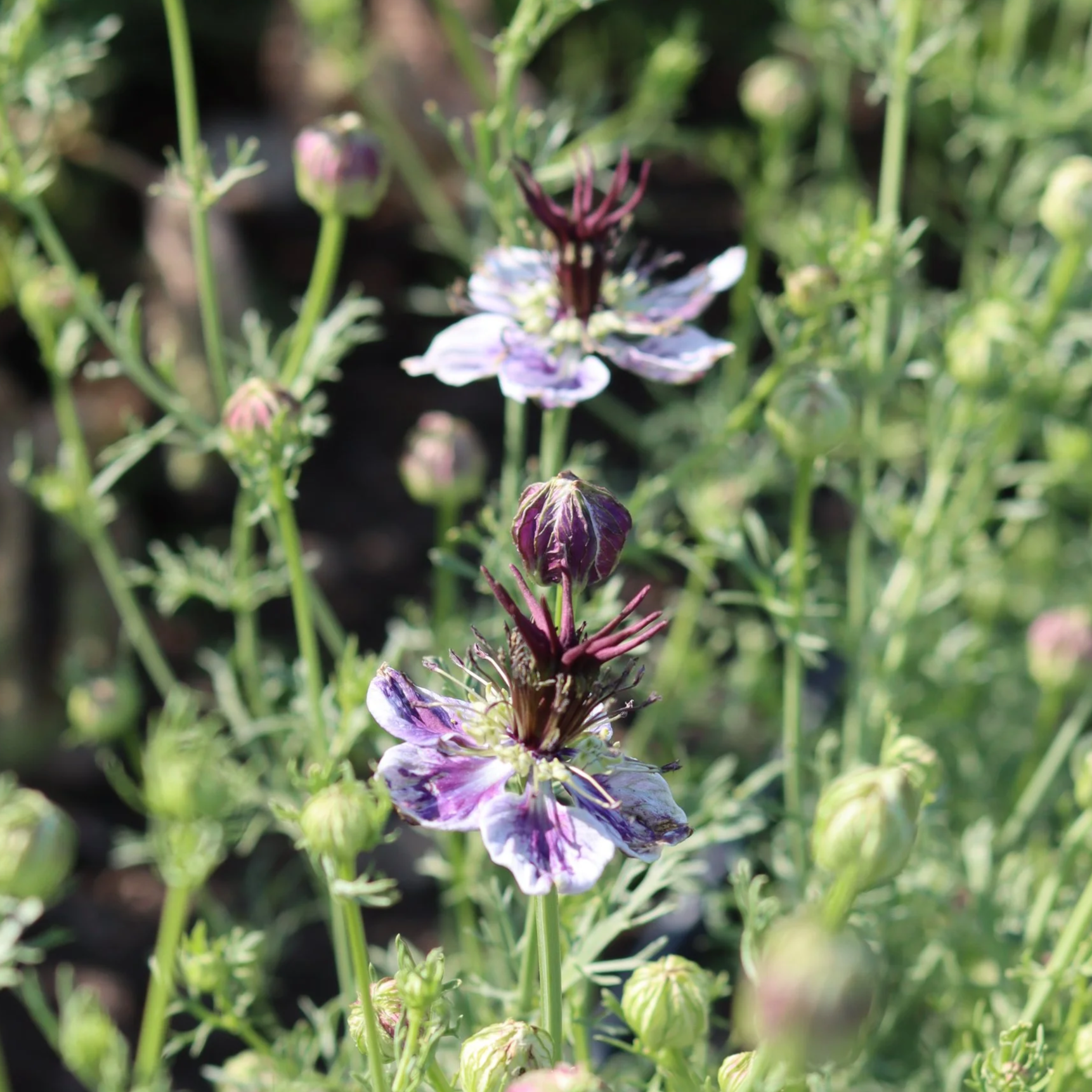
Nigella papillosa
This quirky love-in-a-mist features large blooms with petals splashed in purple-blue markings and a deep purple, twisting center. The flowers are beautiful in fresh arrangements, while the distinctive seed pods add texture and interest to dried arrangements.
Direct sow in early spring. Thin to 10” spacing.
Packet: 100 seeds
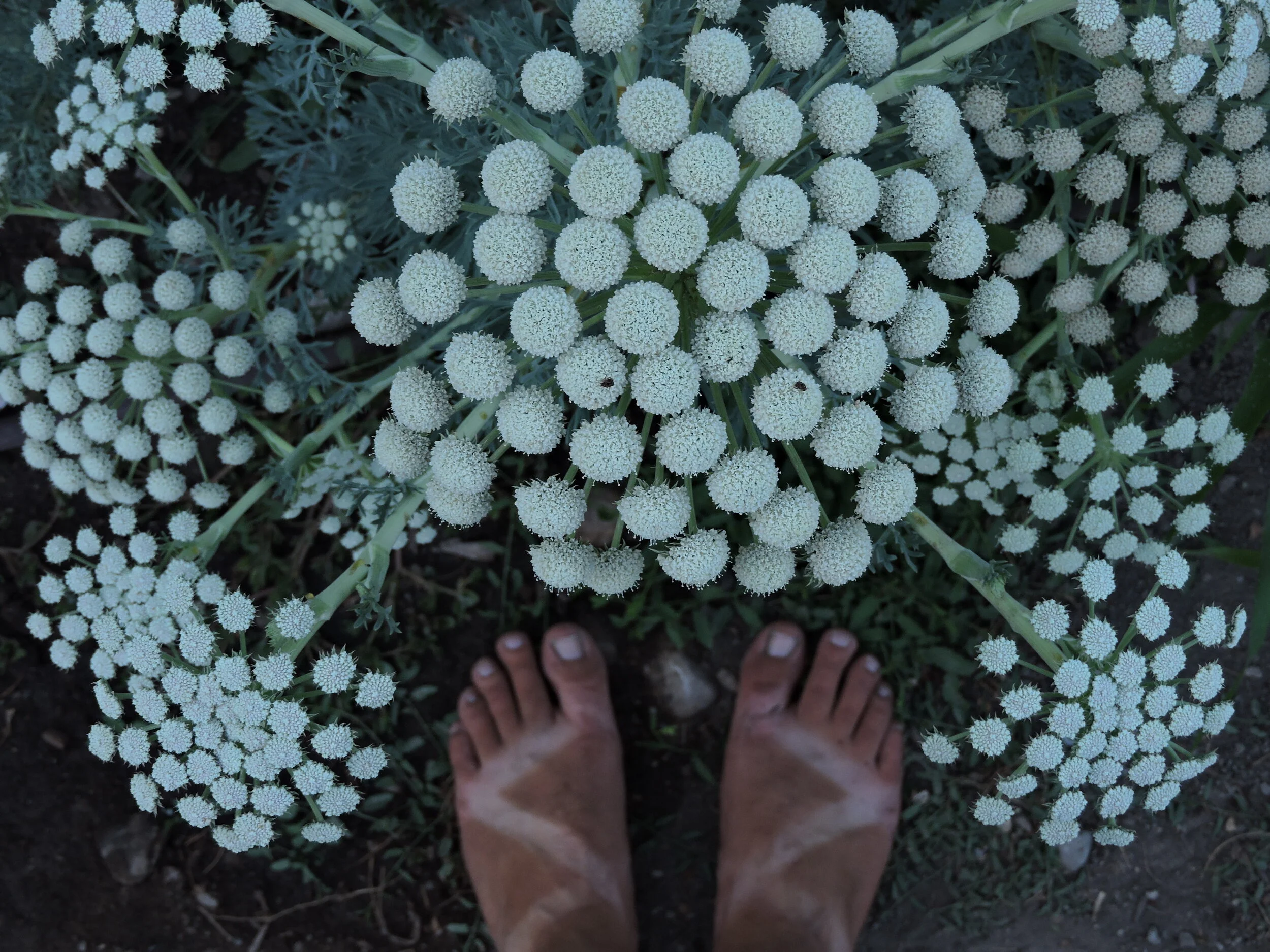
Seseli gummiferum
Some things seem too good to be true: The existence of kittens, Elizabeth Taylor’s performance in Who’s Afraid of Virginia Woolf, dark sky parks in Southern Utah… and Moon Carrot.
This biennial flower will make you audibly gasp when it blooms in its second year. If Hayao Miyazaki animated a carrot flower, and it came to life, this would be it. Pure magic. In the first year it will form a beautiful mound of blue-green dissected leaves which are beautiful in their own right. The blooms make stunning cut flowers, and the dried seed heads are also beautiful in arrangements.
Direct sow seeds in autumn through early spring. They like to germinate when temperatures are still low, and prefer a period of cold stratification to increase germination success. They are fairly drought tolerant, and are great at self-seeding once you get a population established. Thin plants to 1-2’. USDA zone 5-9, and prefers well draining soil.
Are you ready to plant some impossibly beautiful anime realness?
Packet: 200 seeds

Centaurea cyanus
This stunning mix is dominated by rich, classic blue tones, with a beautiful splash of bi-color and purple flowers adding variety to the display. Bachelor’s button seeds are loved by birds, and honeybees are attracted to the flowers. These seeds were grown by our friend Chris of Rustling Aspen Farm in Midway, Utah.
For optimal growth, direct sow the seeds a couple of weeks before your last frost, or in early autumn for earlier blooms. While they do well when transplanted, be sure to plant them before they become root-bound. Regular harvesting encourages continuous edible blooms from early spring all the way to the first hard frost.
Packet: 75 Seeds

Nicotiana alata
As these beautiful white blooms bounce on an evening breeze, they fill the air with a cloud of fresh jasmine-scented perfume. Throughout summer and early autumn, we would often linger at the farm after finishing our work in the evenings in order to spend a few minutes with these calming plants before heading home. This is by far the most fragrant of the nicotiana varieties we grow.
Transplant or direct sow seeds after danger of frost has passed. 1’ spacing is sufficient. Seeds should be lightly spread on the soil surface, and not covered. We suggest growing them near your porch or windows. They are frequently visited by nighttime pollinators, and can tolerate some shade.
Packet: 500 seeds

Nicotiana sylvestris
Fragrant night-blooming nicotiana with avalanches of elegant tubular flowers. Surface sow seeds after your last frost, or start indoors and transplant to 1’ spacing after frost. Woodland nicotiana can tolerate part shade, but won’t be as vigorous. In full sun they can get up to 5’ tall!
Packet: 500 seeds

Talinum paniculatum
Also known as flame flower, this succulent annual can be grown for its heat tolerant summer greens or as a showy ornamental. The flowers create a cloud of pink flowers and ruby seed pods. The greens have a gentle flavor and have a nice thick texture.
Packet: 100 Seeds
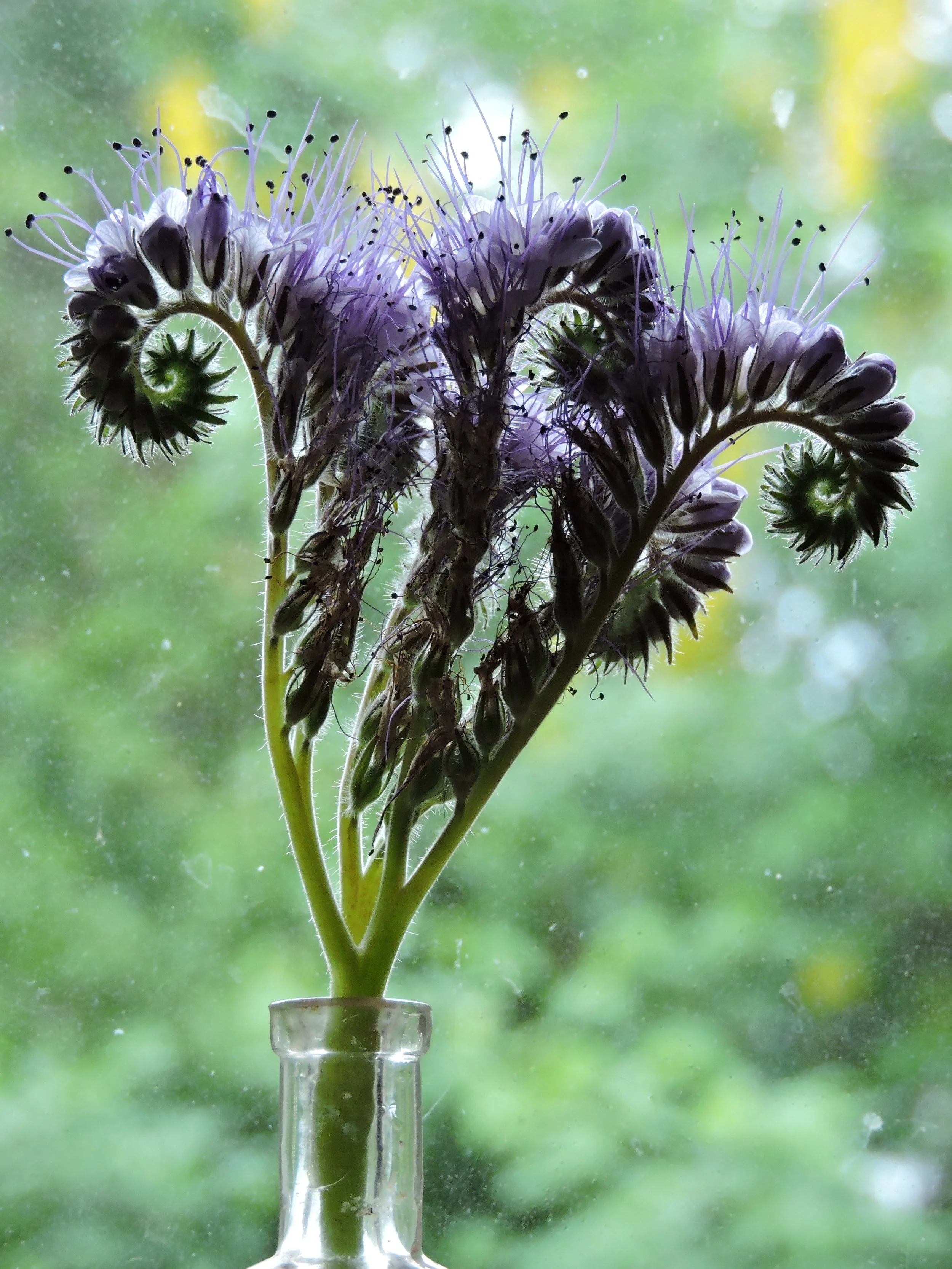
Phacelia tanacetifolia
A Borage family (Boraginaceae) annual wildflower native to the deserts of Southwestern U.S. and Northern Mexico and now widely cultivated. It is grown as a drought tolerant cover crop that brings in an array of pollinators. Its dense, shallow root system helps to improve soil structure. Attracts hover flies, a natural predator of pests like aphids. Heavy nectar production!
Lacy phacelia plants can be smooth or covered in silvery hairs, they can grow 2- 4 feet tall and 1 ½ feet wide and have dissected, ferny leaves. The flowering stems are topped with fiddlehead-shaped flower stems that unfurl in spring and summer giving a long and steady supply of pollen, nectar, and color. The flowers are light to mid-blue and lavender hues with long purple pistils and stamens reaching out for pollination. Plants put on most vegetative growth in milder conditions.
Seeds germinate in cool soils, direct sow in fall or spring. Cover seeds to germinate as exposure to light can prevent germination. Keep consistent moisture until sprouted.
Seedlings can overwinter in areas with mild frosts. In those areas, seeds can be direct sown or started in late summer.
Packet: 150 seeds

Celosia spicata
Dense spikes of silvery pink blooms. Excellent for fresh or dried flower arrangements. Blooms from June through the first frost. Plant seeds indoors and transplant after danger of frost has passed.
Packet: 350 seeds

Celosia argentea var. plumosa
This Celosia adds a brilliant pop of color to your garden and cut arrangements. We enjoy how this variety isn’t completely uniform: There are various shades of reds and purples in the blooms, leaves vary from greenish red, or reddish purple, and a few individuals will have crested flower heads. If you are looking for uniformity, this isn’t the variety for you.
Excellent for fresh or dried flower arrangements, and also has edible leaves. Blooms from June through the first frost. Plant seeds indoors and transplant after danger of frost has passed, or direct sow and thin to 1’ spacing in late spring or early summer.
Packet: 200 seeds

Anthemis sancti-johannis
This perennial evergreen chamomile is closely related to the yellow dyer’s chamomile that we sell, but with rich orange blooms. Beneficial insects like soldier beetles and ladybugs adore them. They make a nice cut flower when the flowers are cut young.
Direct sow seeds a few weeks before your last frost date, or start indoors and transplant after your last frost. They readily self-sow in our area.
Seed Packet: 100 Seeds

Ammi visnaga
Common names: Green mist, toothpick plant, ammi, khella, toothpick weed, bisnaga
Green mist forms a beautiful green sea of lacy, richly green foliage, topped with abundant, cloud-like, white and green-tinged umbrellas of flowers 3-5 inches across! These make excellent cut flowers with sturdy, long stems, and leaves that make an excellent backdrop to floral arrangements. The flowers mature from light green buds to white flowers and back to green seed heads that eventually dry to light tan at the end of their maturation. Unlike many of its carrot family cousins, green mist blooms in one season.
The dried, small flower stems under the umbrella flowers make a decent toothpick — hence the name. Additionally, the leaves are edible (probably best to avoid large quantity) and have a pleasant flavor when chewed. The seeds can be used as a condiment.
The plants have a long history of medicinal uses dating back to the Egyptians for alleviating the pain and passage of kidney stones. The oil of the seeds contain a compound called 'khellin' which is used to treat asthma and renal issues.
Green mist is an annual/biennial member of the carrot family (Apiaceae) which has abundant, nectar and pollen-producing flowers that are excellent for attracting many beneficial insects. They attract diverse pollinators and pest-controlling parasitic wasps, lace-wings, minute pirate bugs, and syrphid flies that will eat pests like aphids, fruit flies, thrips and many others.
Bloom time: mid to late summer.
Uses: Annual/biennial, border plant, beneficial insect plant, container plant, cut flowers, dried flowers, condiment, medicinal, taprooted plant for spring-sown cover crop mix.
Cultivation: Medium to low water use, full sun to part shade. Can overwinter as a rosette if seedlings grow in the fall. Direct sow or sow in flats or pots shallowly and keep evenly moist. Germination occurs in 1-2 weeks.
Packet: 200 seeds

Papaver somniferum
This Slovakian P. somniferum is our favorite breadseed poppy. The flowers produce large beautiful seed pods that remain closed at the crown which prevents seeds from self-sowing in your garden. Poppies with this feature are referred to as "rattle poppies".
Like other breadseed poppies, this variety makes bees lose their minds. As you can see in this picture, the bees literally line up to get some of the nectar. The seeds from this variety are strikingly white, and have a lovely nutty flavor.
Direct sow in early spring. We sow ours between late snowstorms in February or early March.
Packet: 300 Seeds

Papaver somniferum
We just love this deep purple breadseed poppy bred by Lauren Springer.
It lives up to its name, as it is truly the grapiest 💜!
Surface sow in late winter or early spring. In our climate, we sow ours between late snowstorms in February or early March.
Packet: 300 seeds

Papaver rhoeas
This charming population of Shirley/Flanders poppies features an enchanting mix of delicate white flowers, alongside soft shades of light pink and lavender. This is a population that has been mixing for years at Top Crops farm, and we were so excited when they asked if we would like to harvest the seed for our catalog. The soothing, pastel tones of these blooms create a serene, almost dreamlike display in the garden.
Like many poppies, Papaver rhoeas thrives when direct-seeded, preferring cooler temperatures for germination. Scatter the seeds on the soil's surface from autumn to early spring, and enjoy a stunning display of flowers in late spring to early summer.
Packet: 300 Seeds
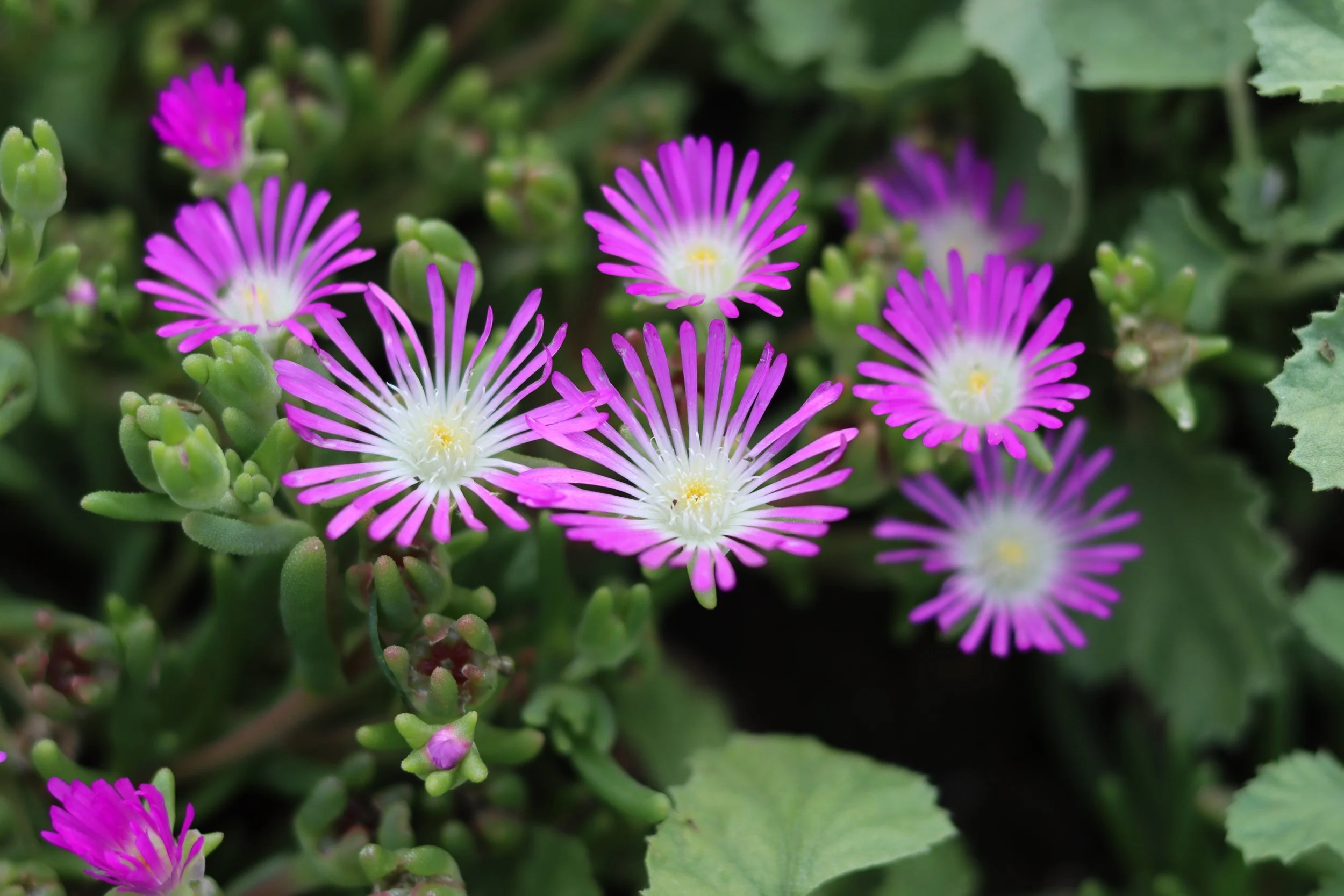
Delosperma floribunda
Perennial edible succulent that forms a mounding groundcover of thick, narrow, evergreen leaves and stems. Grows 3-6” in height by up to a foot and a half in spread. Blooms prolifically from late spring to fall.
The flowers form a carpet of glossy lilac pink petals with bright white centers and a spot of yellow anthers (pollen producing parts) in the middles. The tender stems, new flowers and leaves have a pleasant juicy, toothsome texture and a fresh spinach like flavor. Can be propagated by seed or by cuttings.
Pollinators of many kinds love these flowers!
Grow these iceplants in full sun to part shade in drier, well-draining soils. In areas of high intensity sunlight, such as in high elevations and low ambient humidity, iceplants seem to benefit from slightly more water.
USDA hardiness zones: 6-9 (Zone 5 with special attention to soil drainage and protection from winter wet and freezing winds.)
Start seeds by surface sowing and keeping moist and warm until germination. It can take 15-30 days for germination. Don’t grow in areas that this species is considered a noxious weed.
Packet: 100 seeds

Verbascum bombyciferum
This biennial Verbascum species is a showstopper that will tower over your garden in its second year.
The first year rosettes can be massive, and are covered in beautiful white down. When it blooms in its second year, all of your local bees will flock to them, and the whimsical shapes are sure to make you smile.
Packet: 150 Seeds

Sorghum bicolor
This fast-growing broom corn can reach heights of 8–10 feet by autumn, producing stunning plumes of seed heads that are perfect for both fresh and dried flower arrangements, or for making crafty brooms. If you leave unharvested plants in your garden through autumn and winter, the large seed heads will attract a variety of birds to your garden for a snack. We harvested this lovely seed crop from Top Crops farm.
For best results, direct sow seeds ¼” deep any time between late spring, after your last frost, and early to mid-June. Thin seedlings to 1-foot spacing for optimal growth.
Packet: 100 Seeds

Anthyllis vuleraria var. coccinea
This small nitrogen fixing perennial from Europe has striking red, pink, and orange flowers that are loved by pollinators. Start seed indoors, or direct sow in late spring. A higher percentage of seeds will germinate if you gently scarify them.
They are beautiful in ornamental beds, and look especially cute in rock gardens.
Packet: 40 seeds

(Venidium fastuosum)
70-80 Days
Also known as Monarch of the Veldt, this South African beauty was a favorite of friends and family members that visited our farm this year. Photos can't do it justice.
We start this variety indoors before the last frost, and transplant at 1' spacing after danger of frost has passed. You can also sow seeds outdoors after danger of frost. Many of our plants bloomed continuously from June through October.
Packet: 100 Seeds
(Pisum sativum)
70 days
The prettiest snap pea. We just adore this variety bred by Dr. Alan (Mushroom) Kapular of Peace Seeds in Corvallis, Oregon. These peas grow fast and tall. It was so painful to save them for seed, we wanted to devour them all.
Direct sow in early spring.
Packet: 40 seeds